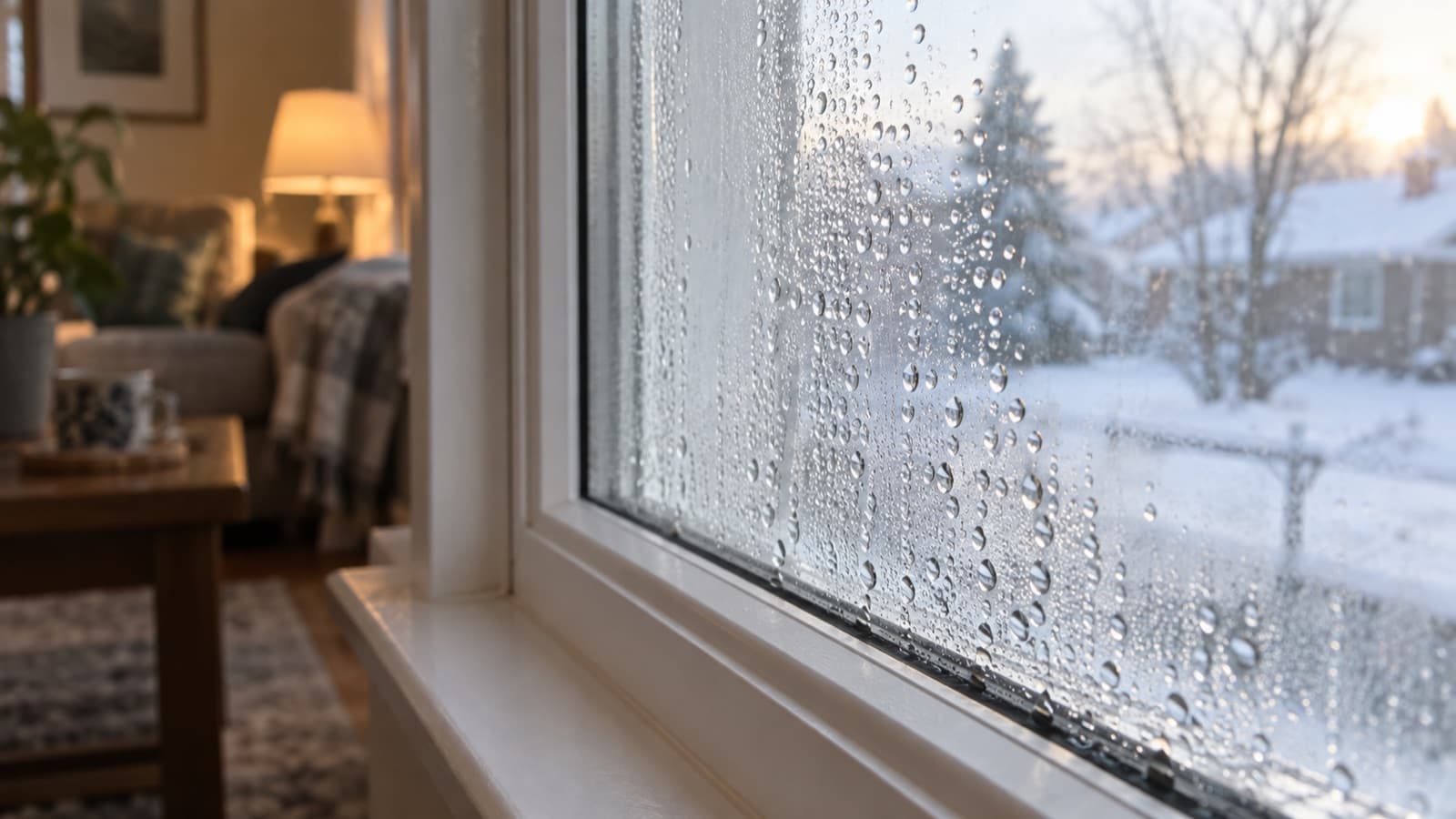
Water on your windows means one of three very different things depending on where it is. On the inside face, it’s a humidity problem and your windows are the messenger. Between the panes, the window has failed. On the outside, congratulations, your windows are working well. Here’s how to tell them apart, what causes each, and what to do.
Three Places, Three Causes
Inside surface
Warm, moist indoor air meets cold glass and drops its moisture. Cause: humidity too high for the outdoor temperature, or glass too cold. Fix: manage humidity, improve the window.
Between the panes
The seal on the insulated glass unit has failed and moist air has got inside. Cause: age, thermal stress, or a defect. Fix: replace the sealed unit or the window.
Outside surface
Dew forms on glass that’s colder than the outside air on a clear, humid morning. Cause: the window is insulating so well the outer pane stays cold. Fix: nothing; it burns off.
Condensation on the Inside
Glass is the coldest surface in a room, so it’s where moisture shows first. A little fog at the bottom corners on the coldest mornings is normal. Water running down the glass, pooling on the sill, or frost on the inside means the room’s relative humidity is too high for that glass temperature. Left alone it stains sills, peels paint, and grows mould in the corners.
Where it shows up tells you something. Bathrooms and kitchens are obvious. Bedrooms are common because two people breathing all night in a closed room adds a surprising amount of moisture. Basements and north rooms are colder, so they condense first. Windows behind heavy curtains or blinds condense more because the covering blocks warm air from reaching the glass.
What Indoor Humidity Should Be in Winter
Natural Resources Canada and CMHC both give the same practical guidance: keep winter indoor relative humidity between about 30 and 50 percent, and lower it as it gets colder outside. A common rule for double-pane windows:
| Outdoor temperature | Max indoor RH to avoid window condensation |
|---|---|
| 0°C | About 40% |
| −10°C | About 35% |
| −20°C | About 30% |
| −30°C | About 25% |
A $20 hygrometer tells you where you are. Triple-pane windows with warm-edge spacers keep the inner glass warmer and tolerate roughly 5 to 10 points more humidity before condensing.
Fixes That Actually Work
- Run bathroom and kitchen fans, and leave the bathroom fan on 20 minutes after a shower. Make sure they vent outside, not into the attic.
- Turn down or turn off the humidifier on the furnace. Many are set for comfort in fall and never lowered.
- Use an HRV or ERV if you have one; if not, one is the long-term answer for a tight house.
- Open blinds and curtains during the day, and keep furniture off the wall below windows so air circulates.
- Vent the dryer outside and check the hose isn’t disconnected.
- Fix the sources: a damp basement, firewood stored indoors, an unvented gas fireplace, or dozens of houseplants all add moisture.
- Insulate around the window. If the frame edges frost while the glass centre is clear, the perimeter wasn’t sealed and insulated; that’s an installation fix.
Fog Between the Panes
Modern windows have a sealed insulated glass unit (IGU): two or three panes, a spacer, a desiccant, and a gas fill, all sealed at the edge. When that seal fails, humid air gets in, the desiccant saturates, and you get fog, streaks, or a milky film you can’t wipe from either side. The argon is long gone by then, so the window insulates like plain double glazing.
Causes: age (seals last 15 to 25 years), thermal stress from dark frames or reflective films, a poor-quality spacer, or physical stress from a frame that’s out of square. Fixes: on a window with a sound frame, the IGU alone can be replaced for a fraction of a new window. On an old or poor-quality window, replace the unit. Check your warranty first: sealed units typically carry 10 to 20 years of coverage, sometimes prorated.
Dew on the Outside
On a cool, still, humid morning in spring or fall, you may find the outside of your new windows covered in dew or even frost, while the old windows next door are clear. This is a good sign. The glass is insulating so well that the outer pane isn’t being warmed from inside, so it cools to the dew point overnight. It clears by mid-morning and does no harm.
Why New Windows Sometimes Show More Condensation
This surprises people. Old, leaky windows dried the house out through constant air exchange. New, tight windows stop that, so the humidity your household generates stays inside and rises. The windows aren’t worse; the house is now holding the moisture it always produced. The answer is ventilation, which is why every tight-envelope renovation should include a look at the exhaust fans and, ideally, an HRV.
When to Worry
- Water pooling daily on sills, or black spotting in the corners: act on humidity now.
- Fog between panes: the window has failed; get it assessed.
- Frost on frames but not glass: installation or insulation issue, not humidity.
- Condensation only on one or two windows in a room: check what’s different (covering, furniture, an unheated corner, a failing unit).
For seasonal prep tips, see preparing your windows for Ontario winters.
Foggy Glass or Frosty Frames?
We'll tell you whether it's humidity, a failed sealed unit, or an installation problem, and what it will cost to fix. Free, no-pressure assessments in London and the GTA.