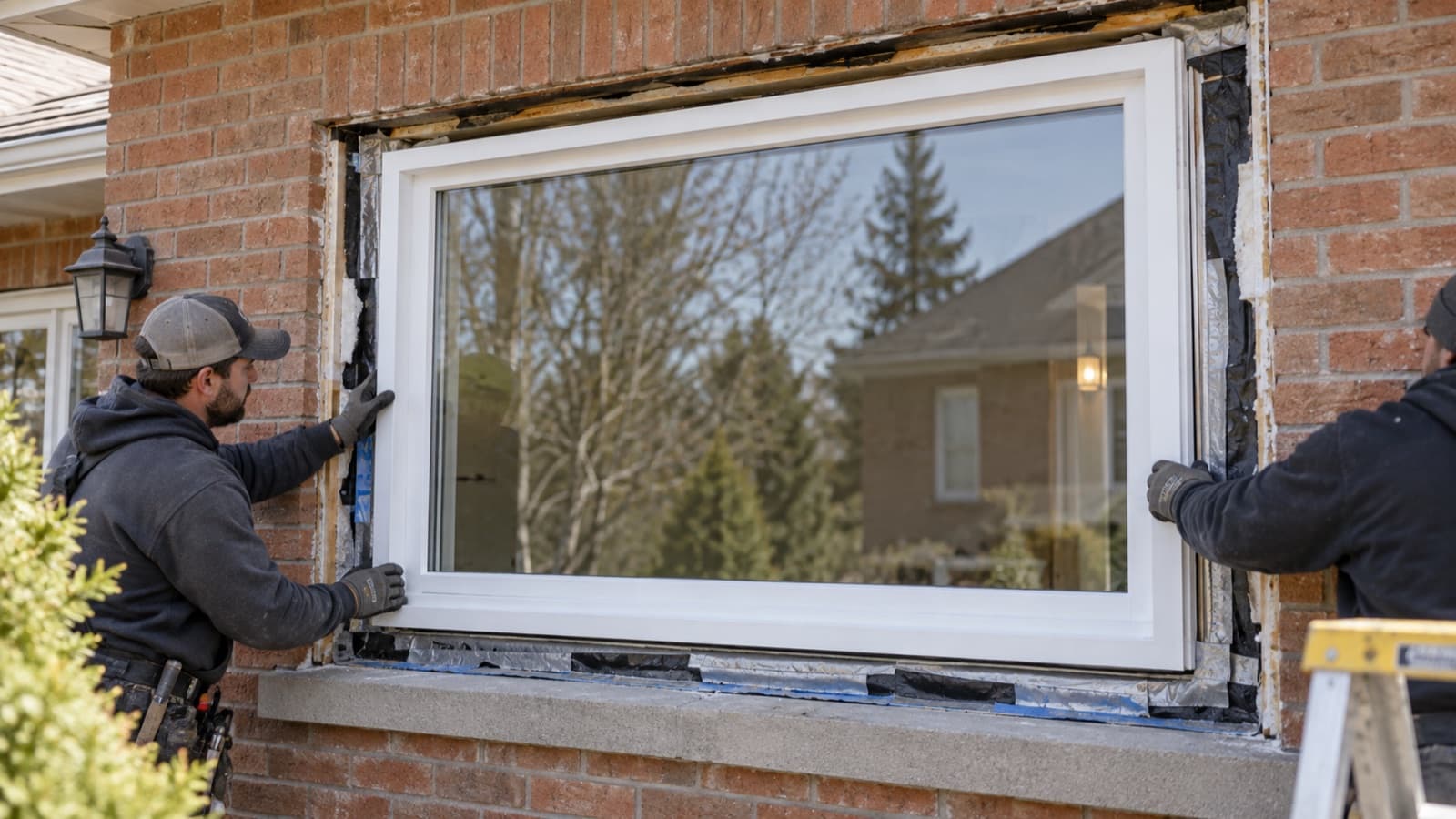
Every window quote you get will be based on one of two installation methods, and the difference is bigger than most homeowners realize. Retrofit (also called insert or pocket) installation keeps your old frame; full-frame (brick-to-brick) installation removes it. One is faster and cheaper. The other fixes problems the first one can’t. Here’s how to tell which one your house actually needs.
What Each Method Actually Involves
Retrofit (insert) installation
The installer removes the old sashes and glass but leaves the existing frame, exterior brickmould, and interior casing in place. The new window, which is a complete unit with its own frame, is sized slightly smaller than the opening and fitted inside the old frame. The gap is insulated with low-expansion foam and sealed with caulking inside and out. Often the exterior is finished with aluminum capping over the old wood.
Full-frame (brick-to-brick) installation
Everything comes out: sashes, frame, brickmould, interior casing, and jamb extensions, right back to the rough opening in the studs or masonry. The installer can then inspect and repair the framing, install new flashing and a sill pan, insulate the full cavity, set the new window directly in the opening, and finish with new brickmould outside and new casing inside. On brick homes this is the “brick-to-brick” measurement you’ll see on GTA quotes.
When Retrofit Is the Right Call
Retrofit gets an unfair reputation as the “cheap” option. Done properly on the right house, it’s a perfectly sound install. It makes sense when:
- The existing frames are solid. No rot, no soft spots, no water staining on the sill or drywall below, and the frame is square.
- The home is relatively new (roughly 1990s onward) with wood or vinyl frames that were flashed correctly the first time.
- You want to keep the interior trim. Retrofit leaves plaster returns, decorative casing, and painted finishes untouched. This matters in older homes with original woodwork.
- Budget or timing is tight. Retrofit is faster, cleaner, and typically several hundred dollars less per window.
- The exterior finish is hard to disturb. Stucco, stone, or certain sidings make full-frame finishing expensive.
The trade-off is glass area. Because the new frame sits inside the old one, you lose roughly an inch or two of visible glass on each side. On a small bathroom window that’s noticeable. On a large living room window it usually isn’t.
When You Need Full-Frame
Some situations don’t leave a choice. A retrofit here just hides the problem for a few years:
- Any rot or moisture damage in the frame, sill, or surrounding wall. Foaming a new window into a rotting frame traps the moisture and accelerates the damage.
- Your windows have already been retrofitted once. A second insert shrinks the glass again and stacks two old frames’ worth of air leaks behind the new unit.
- You’re changing the size, shape, or style of the opening: enlarging a window, converting a slider to a casement of different proportions, or adding an egress window in a basement bedroom.
- The original install had no flashing or a bad sill pan. Common in homes from the 1960s through the 1980s. Only a full-frame install lets you add proper flashing.
- Old aluminum or steel frames without a thermal break. They’ll keep conducting cold no matter what you put inside them.
- The frame is out of square from settling. A new unit forced into a racked frame won’t seal or operate properly.
How to Inspect Your Existing Frames
Natural Resources Canada’s Keeping the Heat In recommends checking for rot, mould, and staining on or around the window, the condition of the glass, putty, and paint, the weatherstripping, and how the hardware operates. You can do most of this in ten minutes with a screwdriver and a flashlight:
- Press the exterior sill and the bottom corners of the frame with a screwdriver tip. Solid wood resists. Rot feels spongy or lets the tip sink in.
- Look at the drywall or plaster below the window for bubbling paint, staining, or a soft patch. That’s water getting past the sill.
- Check the corners of the frame for gaps opening up, which signals movement or shrinkage.
- Measure the diagonals of the opening. If they differ by more than about 6 mm (a quarter inch), the frame is out of square.
- Count the frames. If you can see a frame inside a frame, with the glass set noticeably back from the exterior, a retrofit has already been done.
If any of those checks fail, plan on full-frame for that opening. It’s common for a house to need full-frame on the weather side and retrofit elsewhere, and a good installer will quote it that way rather than one method for the whole house.
Cost and Time Difference
In our experience across London and the GTA, full-frame installation adds roughly $200 to $500 per opening over retrofit once you include new brickmould, jamb extensions, interior casing, and the extra labour. On a 12-window home that’s a difference of $2,500 to $6,000.
On time, a crew can typically retrofit 10 to 15 standard windows in a day. Full-frame on the same house usually runs two days, sometimes three if interior finishing is extensive. Either way you’ll have every opening closed and weather-tight by the end of each day.
Rebates and Code
Both methods qualify for Ontario’s Home Renovation Savings Program rebate of $100 per rough opening, as long as the entire window unit including its frame is new and ENERGY STAR® certified. Natural Resources Canada draws the line at replacing only glass or sashes, which is not eligible. So a retrofit insert counts. A glass-only swap doesn’t.
On code: like-for-like replacement generally doesn’t require a building permit in Ontario. Enlarging an opening, changing the header, or creating a bedroom egress window does. The Ontario Building Code requires an exit window on each floor level containing a bedroom unless that level has an exterior door; the window must provide an unobstructed opening of at least 0.35 m² with no dimension smaller than 380 mm. If a basement bedroom layout needs a larger compliant opening, a retrofit alone cannot create it; discuss a full-frame enlargement and window well with the municipal building department.
Side-by-Side Comparison
| Factor | Retrofit (insert) | Full-frame (brick-to-brick) |
|---|---|---|
| Cost per opening | Lower | Roughly $200–$500 more |
| Time on site | 1 day for most homes | 2–3 days |
| Glass area | Slightly reduced | Full opening, can be enlarged |
| Fixes rot or bad flashing | No | Yes |
| Air sealing and insulation | Around the insert only | Entire rough opening |
| Interior trim | Preserved | Replaced |
| Exterior finish | Capping over old frame | New brickmould, new flashing |
| Best for | Sound frames, newer homes, heritage interiors | Older homes, damage, style or size changes |
| Rebate eligible | Yes | Yes |
How We Decide on Site
We don’t quote a method from the driveway. During a free consultation we probe every sill, check below each window for moisture, look at how the original install was flashed, and talk through what you want from the glass. Then we quote window by window. Sometimes that’s all retrofit. Often on a home built before 1990 it’s a mix, and occasionally it’s all full-frame. What we won’t do is foam a new window into a frame we know is failing.
- Over 20 years installing both methods across London, Mississauga, Oakville, and the GTA.
- No commission. Our installers and estimators have no incentive to upsell full-frame where retrofit is fine, or vice versa.
- Fully insured and WSIB-covered, with a written labour warranty on every installation.
Not Sure Which Your Home Needs?
Book a free consultation. We’ll inspect your frames, explain what we find, and quote each window the way it should be done.