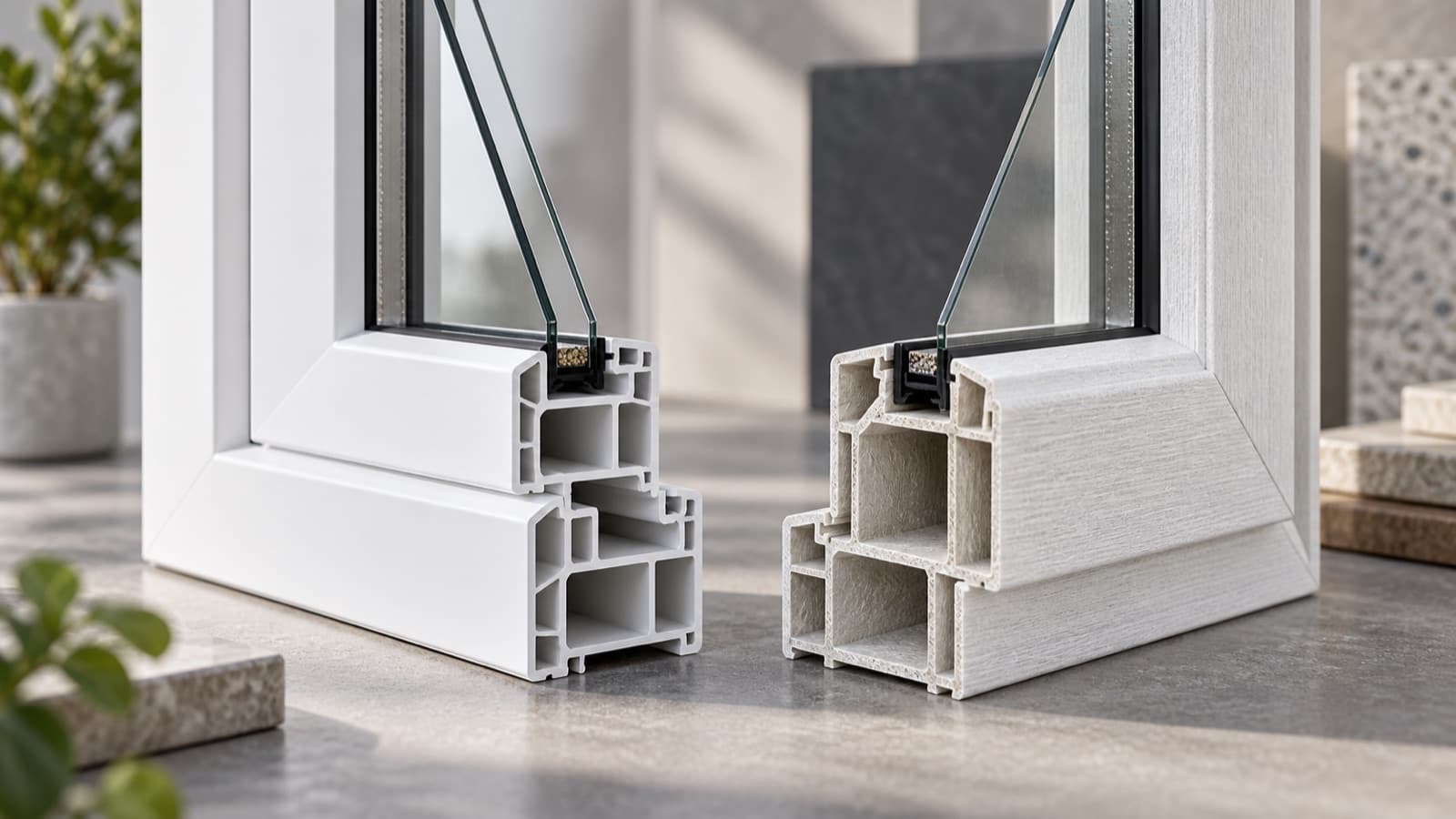
Vinyl is what most Ontario homes get. Fibreglass is what most window salespeople would put in their own house if money were no object. The honest question is whether the 20 to 40 percent premium buys you anything you’ll actually notice over the next 30 winters. Here’s the comparison, without the sales pitch.
What Each Frame Is Made Of
Vinyl frames are extruded from unplasticized PVC with UV stabilizers and impact modifiers. Quality frames are multi-chambered (the hollow cells trap air and add stiffness), have fusion-welded corners, and are often reinforced with steel or composite inserts in larger sizes. Cheap frames have fewer chambers, thinner walls, and mechanically fastened corners.
Fibreglass frames are pultruded: glass fibres are pulled through a resin bath and a heated die, producing a stiff, dense profile that’s roughly 60 percent glass by weight. The result is closer to a structural material than a plastic. Frames are typically painted with a factory-baked finish and can be repainted on site.
Thermal Movement: The Core Difference
Everything else in this comparison flows from one number: how much the frame grows and shrinks with temperature. Vinyl has a coefficient of thermal expansion several times higher than glass. Fibreglass expands at nearly the same rate as the glass it holds.
Why does that matter? The sealed glass unit in your window is bonded into the frame. When a black vinyl frame goes from −25°C on a February night to 60°C in July afternoon sun, it moves noticeably more than the glass does, and every cycle works the sealant and the glazing bead. Over many years that stress is a contributor to seal failure, which is the foggy glass you see in 15-year-old vinyl windows. Fibreglass and glass move together, so the seal is left alone. Window makers design vinyl to handle this, and quality vinyl does for decades, but fibreglass sidesteps the problem entirely.
Thermal movement also shows up as operation. A vinyl casement that’s slightly stiff in the summer and slightly loose in the winter is expanding and contracting. Fibreglass units feel the same year-round.
Insulation and Energy Ratings
Both materials are poor conductors, which is what you want in a frame. Hollow multi-chamber vinyl has slightly better inherent insulation than solid fibreglass, but fibreglass frames are usually filled with foam insulation, and their strength lets manufacturers use slimmer profiles and thicker glass packages. In practice, whole-window ratings are very close between a good vinyl and a good fibreglass window with the same glass.
Check the actual label rather than the material. Both can be ENERGY STAR® certified (ER of 34 or higher, or U-factor of 1.22 W/m²·K or lower), and both can reach ENERGY STAR Most Efficient (ER 40 or higher, or U-factor 1.05 or lower) with triple glazing. Because fibreglass frames can carry heavier triple-pane units without sagging, they’re more common at the top of the ratings list, but that’s the glass doing the work.
Strength, Sightlines, and Big Windows
Fibreglass is several times stiffer than vinyl. That translates into:
- Narrower frames and more glass for the same opening, which is a visible difference on small windows and a big one on a wall of windows.
- Larger single units. A tall casement or a wide picture window that would need steel reinforcement in vinyl is routine in fibreglass.
- No sag on heavy triple-pane sashes over time, so casements keep closing square and sealing properly.
- Better screw retention for hinges and locks, which is why fibreglass hardware tends to stay tight longer.
For a standard 30 by 48 inch bedroom window, none of this changes much. For a modern home with big openings and black frames, it’s the reason fibreglass is specified.
Colour, Dark Frames, and Fading
Dark and black windows are the most requested look in Ontario right now, and they are where the two materials diverge most.
Vinyl is inherently white or beige through its body. Dark colours are achieved with a laminate or a painted exterior. Modern versions are durable, but a dark vinyl frame in full sun can reach temperatures that push the material toward its softening point, which is why manufacturers restrict certain colours, void warranties on some dark laminates in high-sun exposures, or require heat-reflective pigments. Interior colours are usually limited to white or a few wood-grain laminates.
Fibreglass takes paint the way a car does. Black, charcoal, and deep colours are standard, hold up in sun, and can be different inside and out. If you ever want to change the colour, you can repaint. That’s not an option with vinyl.
Lifespan and Warranty
Industry sources consistently put quality vinyl at 20 to 35 years and fibreglass at 40 to 50+ years. Vinyl’s end of life usually arrives as seal failure, brittle or chalky frames on sun-facing walls, or worn hardware that the softened frame can no longer hold. Fibreglass tends to outlive its glass units; you might replace a sealed unit at year 30 and keep the frame.
Warranties reflect that. Most vinyl windows carry a “lifetime limited” warranty that is often prorated after 10 to 20 years and commonly excludes dark colours from fade coverage. Fibreglass warranties vary by maker but are usually 20 years to lifetime on the frame with finish coverage included. As always, read what is actually covered, and remember that no manufacturer warranty covers installation errors.
Cost in Ontario
2026 GTA pricing guides put installed vinyl at roughly $600 to $1,200 per standard window and fibreglass at $800 to $1,500, with southwestern Ontario running somewhat lower. As a rule, expect fibreglass to cost 20 to 40 percent more than the same window in vinyl. On a 15-window house that’s about $3,000 to $6,000 extra.
| Factor | Vinyl | Fibreglass |
|---|---|---|
| Installed cost (standard window) | $600–$1,200 | $800–$1,500 |
| Expansion vs. glass | Several times higher | Nearly identical |
| Frame stiffness | Moderate; reinforced when large | High |
| Frame width / glass area | Wider frames | Slimmer frames, more glass |
| Dark colours | Laminate or paint, some limits | Any colour, repaintable |
| Energy ratings | ENERGY STAR readily | ENERGY STAR readily; more Most Efficient options |
| Maintenance | None | None; optional repaint |
| Lifespan | 20–35 years | 40–50+ years |
Which Should You Choose?
Choose vinyl if…
You want white or light frames, your windows are standard sizes, budget is a priority, or you expect to move within 10 to 15 years. Spend the savings on triple glazing and a good installer rather than on the frame.
Choose fibreglass if…
You want black or dark frames, you have large openings or a wall of glass, you’re staying long term, or you’ve had vinyl seals fail on a sunny wall before. It’s the frame that will still be square and sealed when your kids own the house.
A sensible middle path we quote often: fibreglass on the sun-facing front elevation where the dark frames are, vinyl on the sides and back. You get the look and the durability where it counts, at a fraction of the whole-house premium.
See Both Priced for Your Home
We supply and install both materials and will quote them side by side, with the same glass, so the comparison is fair.