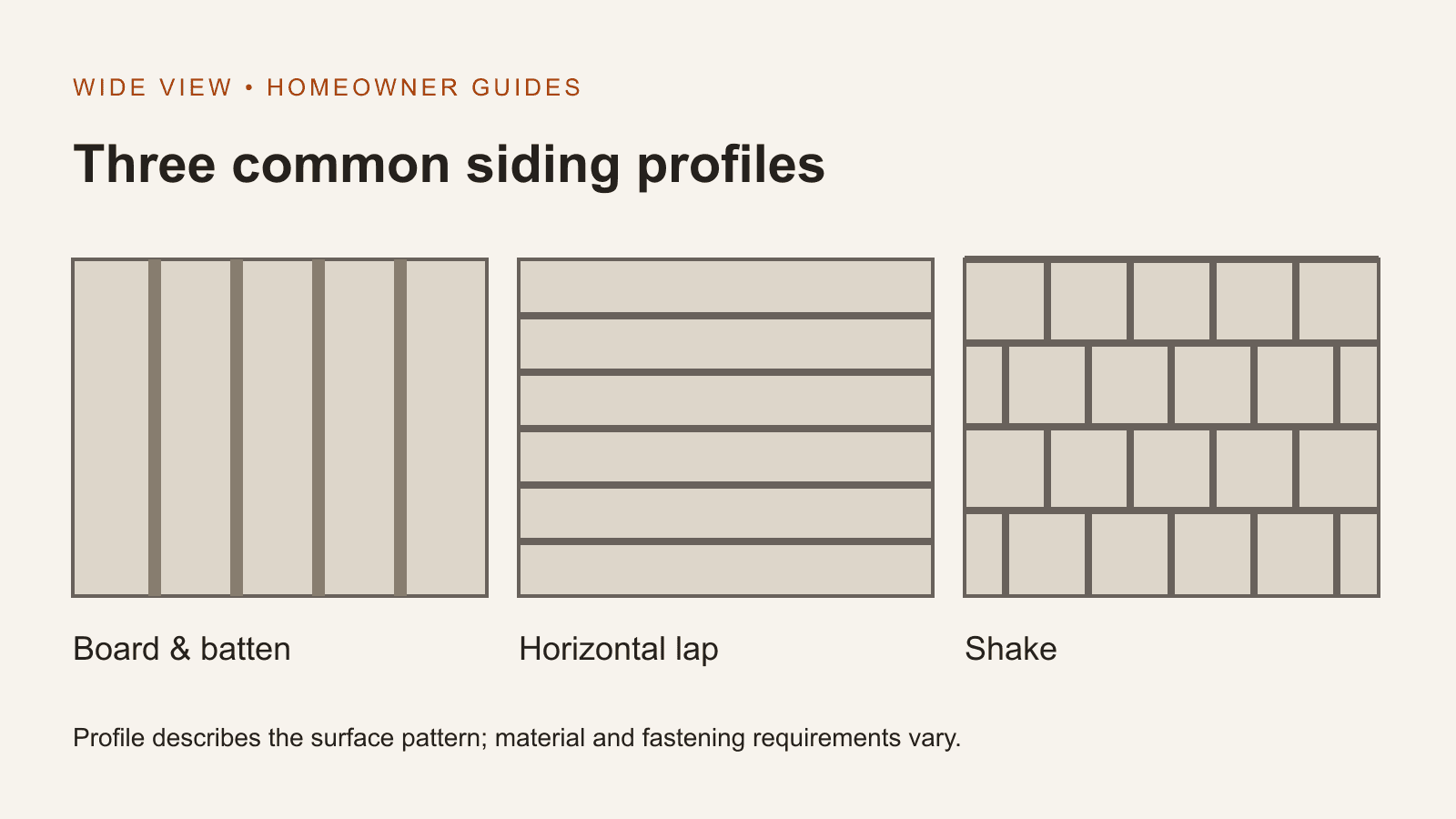
Before you choose a siding colour or even a material, you choose a profile: the shape of the boards and how they go on the wall. Lap, board and batten, and shake each give a house a completely different character, and they’re available in vinyl, fibre cement, engineered wood, and real wood. Here’s a guide to the main profiles, what they cost, and where each one belongs.
Horizontal Lap (Clapboard)
Long horizontal boards, each overlapping the one below. The default siding profile in North America for 300 years and still the majority of what goes on Ontario homes. Available in exposures (the visible height of each board) from about 4 to 8 inches; narrower exposures look more traditional and formal, wider ones more contemporary. Smooth or wood-grain texture. Lap makes a house look longer and lower and hides slight wall irregularities well.
Best for: almost any house, especially colonial, cape, ranch, and bungalow styles. Materials: vinyl, fibre cement (HardiePlank), engineered wood, cedar.
Dutch Lap and Beaded
Dutch lap is a lap board with a concave notch along the top edge that throws a deeper shadow line. It’s a mostly vinyl profile and is popular on 1990s to 2010s subdivisions. Beaded lap has a rounded bead along the bottom edge; it’s a historic southern profile that reads as upscale and traditional. Both cost about the same as standard lap in vinyl.
Board and Batten (Vertical)
Wide vertical boards with narrow strips (battens) covering the joints. Originally a barn and farmhouse siding, now the signature of the modern farmhouse look and common as an accent on gables, entries, and garage bump-outs. It makes a house look taller and draws the eye up. Vertical siding needs horizontal strapping or a different nailing base than lap, so it’s a bit more labour, and it must be detailed carefully at the bottom to keep water out of the board ends.
Best for: farmhouse, craftsman, modern, and as a gable accent. Materials: vinyl (as a single panel that imitates board and batten), fibre cement (HardiePanel with battens or Hardie’s dedicated board-and-batten line), engineered wood, cedar.
Shake and Shingle
Small individual pieces, or panels moulded to look like them. Shingles are uniform and smooth, shakes are thicker and rougher with staggered or straight bottom edges. Historically cedar; now mostly vinyl or fibre cement panels that install like lap. Shake adds texture and cottage or coastal character, and it’s the classic gable accent above lap siding. Used on a whole house it’s a strong look and a higher cost.
Best for: gables and dormers, cottage, craftsman, Cape Cod, and Victorian homes. Materials: vinyl panels, fibre cement (HardieShingle), engineered wood, cedar.
Panel and Modern Vertical
Large flat panels (fibre cement or metal) with expressed joints, or narrow vertical planks without battens. These are the profiles on contemporary builds, often combined with wood-look accents. They demand a flat, well-prepared wall and precise trim details, and they’re usually the most expensive to install because there’s nowhere to hide an imperfection.
Mixing Profiles
Mixing profiles is how a house avoids the flat, single-material look. The rules that work: lap on the main body, a second profile on gables or a single feature (board and batten, shake, or wood-look), and a clear horizontal or vertical line where they meet, usually a trim board. Keep the second profile to a third of the visible wall or less. Two profiles in the same colour add depth; two profiles in two colours add contrast; three profiles is usually too many.
Cost Comparison
Installed 2026 Ontario ranges, as a premium over standard lap in the same material:
| Profile | Vinyl (installed/sq ft) | Fibre cement (installed/sq ft) | Relative to lap |
|---|---|---|---|
| Standard lap | $6–$12 | $12–$18 | Baseline |
| Dutch lap / beaded | $6–$12 | $13–$19 | About the same |
| Board and batten | $8–$14 | $14–$22 | +15–30% |
| Shake / shingle | $9–$16 | $16–$24 | +25–50% |
| Flat panel / modern vertical | n/a | $16–$26 | +30–60% |
Because accents are a small share of the wall, adding shake to two gables typically adds only a few hundred to a couple of thousand dollars to a whole-house job.
Which Profile for Which House
1950s–70s bungalow or side-split
Wide-exposure lap for a modern update, or standard lap with board and batten on the entry.
1980s–2000s two-storey
Lap on the body, shake or board and batten in the gables. Instantly less builder-basic.
Century home
Narrow-exposure lap or beaded lap with shingle gables, in historic colours. Check heritage rules first.
Modern build or addition
Panel or narrow vertical with a wood-look accent, or wide lap in a dark colour.
Our siding materials guide covers what each profile is made of, and our colour guide covers the rest of the decision.
Choosing a Siding Profile?
We'll bring samples of lap, board and batten, and shake in the materials you're considering, and quote the mix you like.