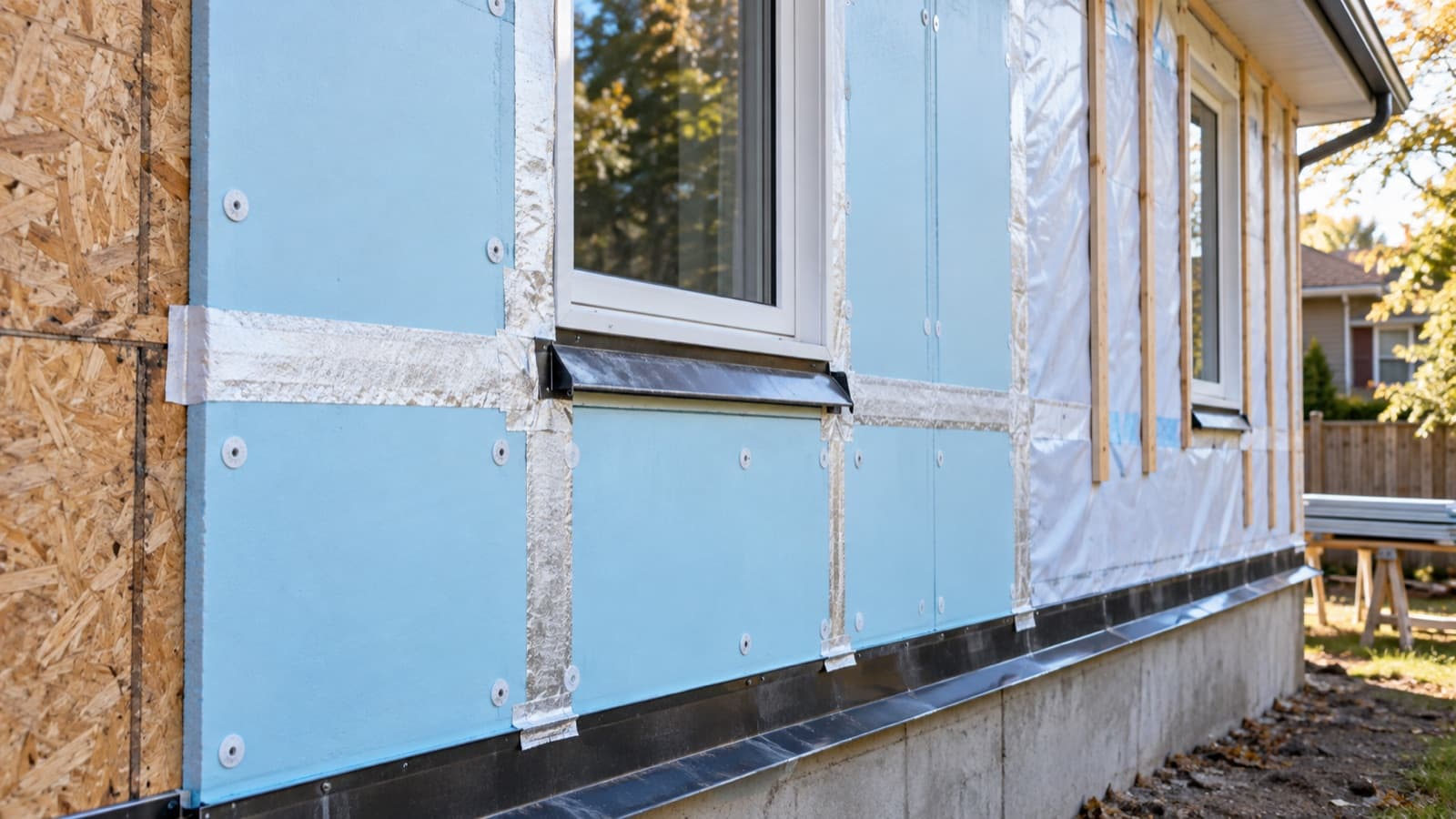
“New siding will make your house warmer” is one of the most common claims in exterior sales, and it’s mostly wrong. Siding itself insulates almost nothing. What’s underneath it can insulate a great deal, and a siding project is the one time in 30 years that the wall is open and you can put it there cheaply. Here’s the real picture: what siding does, what house wrap does, what foam does, and what to ask for.
What Siding Actually Insulates
Insulation is measured in R-value; higher is better. A typical Ontario wall from the 1970s onward has R-12 to R-20 of batt insulation between the studs. Here’s what the cladding adds:
| Cladding | Approximate R-value |
|---|---|
| Standard vinyl siding | R-0.6 |
| Fibre cement (James Hardie) | R-0.35 to R-0.65 |
| Aluminum | R-0.6 |
| Cedar lap, 3/4 inch | R-0.8 to R-1.0 |
| Insulated vinyl siding (foam-backed) | R-2.0 to R-3.5 |
| 1 inch rigid foam board under any siding | R-4 to R-6.5 |
So swapping old aluminum for new vinyl or Hardie changes the wall’s R-value by essentially zero. The house may feel tighter afterward, and that’s real, but it comes from air sealing and wrap, not the siding.
House Wrap: Air and Water, Not Heat
House wrap (or building paper on older homes) is the layer under the siding that sheds water and, when taped at the seams, blocks air leakage. It has no R-value. But air leakage is a large share of heat loss in an older house, and many pre-1990 homes have torn paper or nothing at all under their siding. New, properly taped wrap with flashed windows can make a noticeable difference in drafts and comfort. That’s the “warmer” people feel after re-siding.
Insulated Vinyl Siding
Insulated vinyl has a shaped rigid foam (EPS) backing bonded to each panel. Real tested values run R-2 to R-3.5. That’s a genuine improvement, and the foam also stiffens the panel (flatter walls, fewer waves, better impact resistance) and quiets the house a little. It costs about $2 per square foot more than standard vinyl installed. It’s the easiest insulation upgrade because it adds no extra steps and no extra wall thickness to deal with at windows and doors.
Continuous Exterior Foam
The bigger move is a layer of rigid foam board over the whole wall before the siding goes on. One inch of XPS or polyiso adds R-5 to R-6.5 continuously, which is worth more than the number suggests because it covers the studs. Studs are about 20 to 25 percent of a wall and conduct heat straight through the batts; continuous foam stops that thermal bridging. It also keeps the sheathing warmer, which reduces condensation risk inside the wall.
The complications: the wall gets thicker, so windows and doors need jamb extensions or bucks, trim details change, and the foam has to be detailed as a drainage plane or installed over the wrap with a rain screen gap. One inch is straightforward; two inches or more is a bigger job that’s best combined with window replacement. Cost is roughly $2 to $4 per square foot installed for one inch, on top of the siding.
The Air-Sealing Bonus
With the walls open, a good crew seals every penetration: around windows and doors, hose bibs, dryer and range vents, electrical boxes, and the top and bottom of the wall. Sealing those with foam and tape is cheap and, in an older house, can cut air leakage by a meaningful fraction on its own. Make sure it’s in the scope; it’s the step that gets skipped when a crew is racing.
What It’s Worth in Ontario
Take a two-storey home with 2,000 square feet of wall at R-14 nominal (about R-11 effective with thermal bridging). Adding one inch of continuous foam takes the wall to roughly R-17 effective, a 50 percent improvement in the wall’s resistance. Walls are typically 15 to 25 percent of a house’s heat loss, so that’s a heating-bill reduction in the high single digits to low teens in percentage terms, plus air sealing gains on top. On a $2,500 annual heating bill, that’s a few hundred dollars a year, for an upgrade that costs $4,000 to $8,000 while the wall is already open, and that would cost far more to do any other time.
Insulated vinyl alone gives roughly half that wall improvement for about half the cost. Standard siding gives none.
Rebates
Ontario’s Home Renovation Savings Program pays rebates for exterior wall insulation and air sealing as part of a bundled retrofit with a home energy assessment, and wall insulation rebates can be substantial. Siding itself is not rebated, but foam added under it is, provided it meets the program’s R-value thresholds and is documented. If you’re re-siding anyway, book the assessment first; see our rebate guide for how the program works.
What to Ask For on Your Quote
- New house wrap, taped seams, and membrane flashing at every window and door.
- Air sealing of all penetrations, listed as a line item.
- A priced option for insulated vinyl (if vinyl) and for one inch of continuous foam (any siding).
- How windows and doors will be extended if foam is added.
- Rot repair unit pricing, since sheathing is often found damaged once open.
Re-Siding Anyway? Insulate While the Wall Is Open.
We quote standard, insulated vinyl, and continuous-foam options side by side so you can see what each adds. Serving London and the GTA.