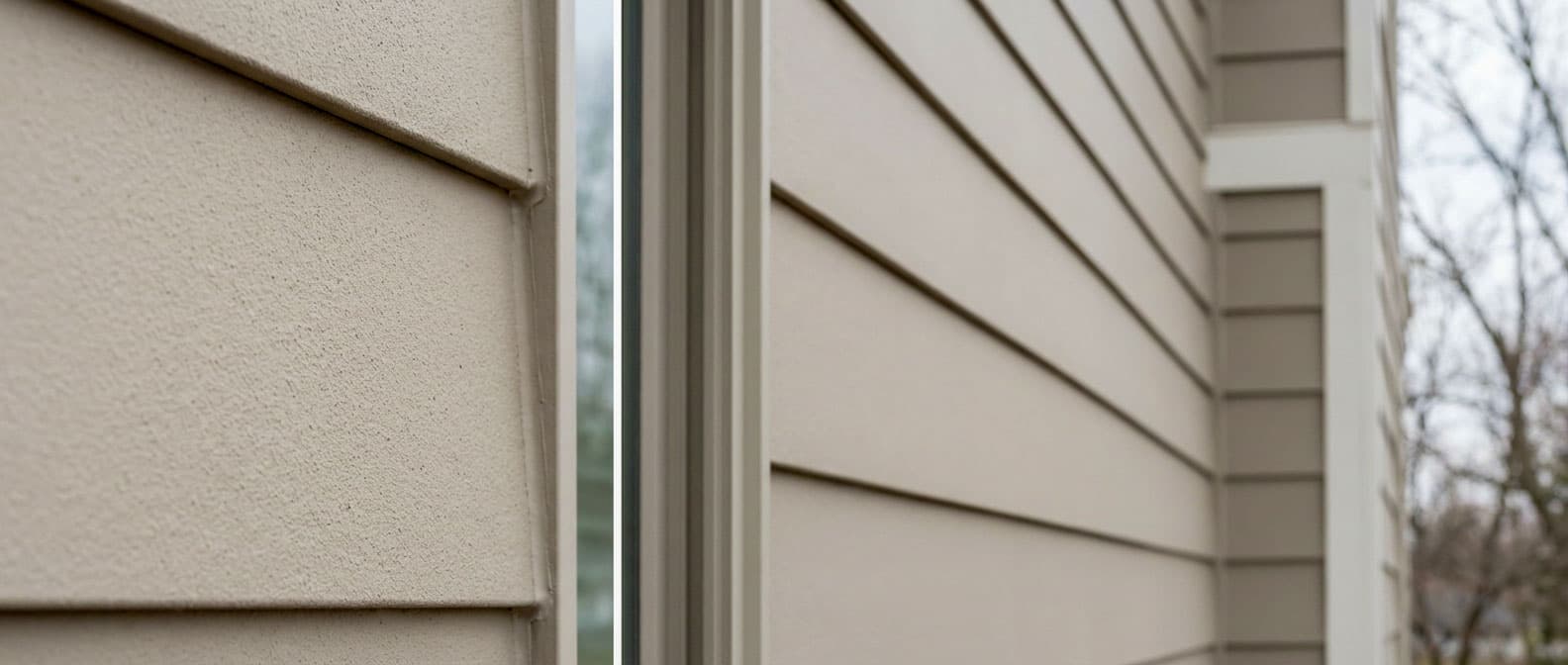
If you’ve narrowed your siding choice to two options, it’s almost always these two: James Hardie fibre cement or vinyl. One costs roughly twice as much as the other. The question is whether it’s worth it for your house, your budget, and how long you plan to stay. Here’s the comparison over a realistic 20-year ownership window, with Ontario prices and Ontario weather.
What Each Material Is
Vinyl siding is extruded PVC, usually 0.040 to 0.046 inches thick in mid-grade products, with the colour running all the way through the panel. Insulated vinyl adds a bonded foam backing that stiffens the panel and adds a modest R-value.
James Hardie siding is fibre cement: a mix of Portland cement, sand, cellulose fibre, and water, pressed into planks, panels, and shingles. It’s heavy, rigid, and takes paint like wood. For Ontario, Hardie sells its HZ5® product line, engineered for climates with freezing temperatures, snow, ice, and big seasonal swings. It’s available pre-finished with ColorPlus® Technology, a factory-baked finish, or primed for painting on site.
Installed Cost in Ontario
2026 Ontario pricing guides put the two materials in clearly different brackets:
| Vinyl | Insulated vinyl | James Hardie | |
|---|---|---|---|
| Installed cost per sq ft | $6–$12 | $8–$14 | $12–$22 |
| 2,000 sq ft of wall | $12,000–$24,000 | $16,000–$28,000 | $24,000–$44,000 |
| Expected lifespan | 20–40 years | 30–40 years | 50+ years |
Why the gap? Hardie planks weigh roughly three times what vinyl does, need to be cut with dust-controlled tools, require blind nailing into studs at set spacing, and demand precise flashing and caulking at every joint. It’s a two-person install with more skill and more hours. The product itself also costs more per square. On a complex house with lots of corners, gables, and trim, the labour premium widens.
Durability in Ontario Weather
Southwestern Ontario and the GTA throw a specific set of problems at siding: 60-plus freeze-thaw cycles a winter, humid summers, hail, wind off the lakes, and hot afternoon sun on south and west walls.
Vinyl
Vinyl handles moisture perfectly because it can’t absorb water. Its weak points are thermal movement and impact. Panels expand and contract noticeably between −25°C and +30°C, which is why they’re hung loose on the nails; over-nailed vinyl buckles in summer and cracks in winter. Cold vinyl is brittle, so a stray hockey puck, hail, or a lawnmower stone can crack a panel in January. Dark colours on older vinyl also faded and chalked, though modern capstock finishes have improved that a lot.
James Hardie
Fibre cement doesn’t expand or contract with temperature in any meaningful way, doesn’t get brittle in cold, and shrugs off hail and impacts that would crack vinyl. Hardie states its HZ5 products “resist shrinking, swelling and cracking even after years of wet or freezing conditions.” The material’s vulnerability is moisture at unsealed cut edges and joints. If an installer skips flashing or leaves raw ends unprimed, water can wick in and cause swelling at the edges over time. In other words, Hardie is only as good as the install, and it punishes sloppy work more than vinyl does.
Appearance and Curb Appeal
This is where Hardie earns a lot of its premium. Planks are thicker, with deeper shadow lines, a realistic cedar texture, and crisp corner and trim details. From the sidewalk it reads as painted wood. Vinyl has come a long way, with thicker premium panels and better textures, but the visible seams where panels overlap, the J-channel around windows, and the slight waviness on long runs still say “vinyl” to a trained eye.
Colour is the other difference. Hardie can be painted any colour, including deep charcoals and blacks that vinyl manufacturers restrict because of heat distortion. Its ColorPlus finish is baked on in multiple coats, so it fades more slowly than site-applied paint. Vinyl’s colour is what it is for life; you can’t repaint it well, so if you tire of it, you replace it.
For resale, national cost-versus-value surveys have consistently placed fibre cement siding among the exterior projects with the highest return at sale. Vinyl replacement also scores well, but a Hardie exterior on a good street tends to be a selling feature rather than just a maintenance item.
Maintenance Over 20 Years
Vinyl
Rinse it once a year with a hose and a soft brush. Replace any cracked panels. That’s essentially it. Near-zero maintenance, no repainting ever.
James Hardie
Hardie recommends a low-pressure rinse and soft brush once or twice a year, and no pressure washing. Inspect caulking at joints every few years and touch up as needed. Plan on repainting around year 15 to 20 with ColorPlus, sooner with site-painted product.
That repaint is the number to budget for. Painting a 2,000 sq ft Hardie exterior in Ontario typically runs several thousand dollars, and it’s a cost vinyl owners simply never face. On the flip side, it’s also an opportunity to change the colour of your house without residing it.
Warranties, Read Carefully
Both materials come with long warranties, but they’re structured very differently.
James Hardie backs its siding and trim with a 30-year, non-prorated limited warranty. Non-prorated means the coverage doesn’t shrink each year; a defect in year 25 is covered the same as year 2. The ColorPlus factory finish carries a separate 15-year limited warranty against peeling, cracking, and chipping. The warranty is transferable to a new owner.
Vinyl is usually sold with a “lifetime limited” warranty, which sounds better but almost always prorates: coverage drops by a set percentage every year after an initial period, so by year 20 or 25 you may be covered for a fraction of replacement cost. Fade coverage is typically narrower still, and often excludes darker colours. Transfer to a new owner usually converts “lifetime” to a fixed term like 50 years or drops to a shorter period.
Fire, Impact, and Insurance
Fibre cement is non-combustible with a Class A fire rating. Hardie states its siding “will not ignite when exposed to a direct flame, and will not contribute fuel to a fire.” Vinyl is a plastic; it melts and deforms at relatively low temperatures and burns once ignited. This matters most on tightly spaced lots in the GTA where a neighbour’s fire, a barbecue placed against the wall, or radiant heat from a nearby structure can damage vinyl.
On impact, fibre cement wins clearly against hail and debris. Some insurers offer modest premium discounts for non-combustible cladding; it’s worth a call to your broker, but don’t expect it to swing the decision on its own.
The 20-Year Math
Take a typical two-storey home with about 2,000 square feet of wall area, mid-range products, and installation by a qualified crew:
| Over 20 years | Quality vinyl | James Hardie (ColorPlus) |
|---|---|---|
| Installed, day one | ~$18,000 | ~$32,000 |
| Repainting | $0 | ~$6,000–$10,000 once, near year 15–20 |
| Repairs | A few cracked panels, a few hundred dollars | Caulk touch-ups, minimal |
| Condition at year 20 | Serviceable; likely faded on sun-facing walls; mid-life | Freshly painted; less than half of expected life used |
| Approximate 20-year total | ~$18,500 | ~$40,000 |
Vinyl is cheaper over 20 years by a wide margin, and that’s the honest conclusion. Hardie only closes the gap if you weigh the things the table can’t price: a materially better-looking house, higher resale appeal, fire resistance, and an exterior that will likely outlast a second round of vinyl. If you plan to sell in five years, vinyl is the rational choice. If this is a long-term home on a street where exteriors matter, Hardie’s premium is easier to justify.
Which Should You Choose?
Choose vinyl if…
Budget is the priority, you want zero maintenance, you’re re-siding a rental or a home you’ll sell within a decade, or the house is a simple shape where seams and J-channel are less visible. Spend a little extra for a thicker premium panel or insulated vinyl.
Choose James Hardie if…
You’re staying long term, you want a painted-wood look with dark or custom colours, curb appeal and resale matter on your street, fire resistance is a concern, or you’ve had vinyl crack or warp before. Budget for the repaint and insist on an installer who follows Hardie’s clearance and flashing details.
A third option some of our customers choose: Hardie on the front elevation where it’s seen, vinyl on the sides and back. It captures most of the curb appeal at a fraction of the premium.
For a broader look at every material including engineered wood, aluminum, and cedar, see our complete guide to siding materials for Ontario homes.
Get Both Options Priced for Your Home
We’ll measure your walls and quote vinyl and James Hardie side by side, with trim and installation included, so you can compare real numbers instead of estimates.