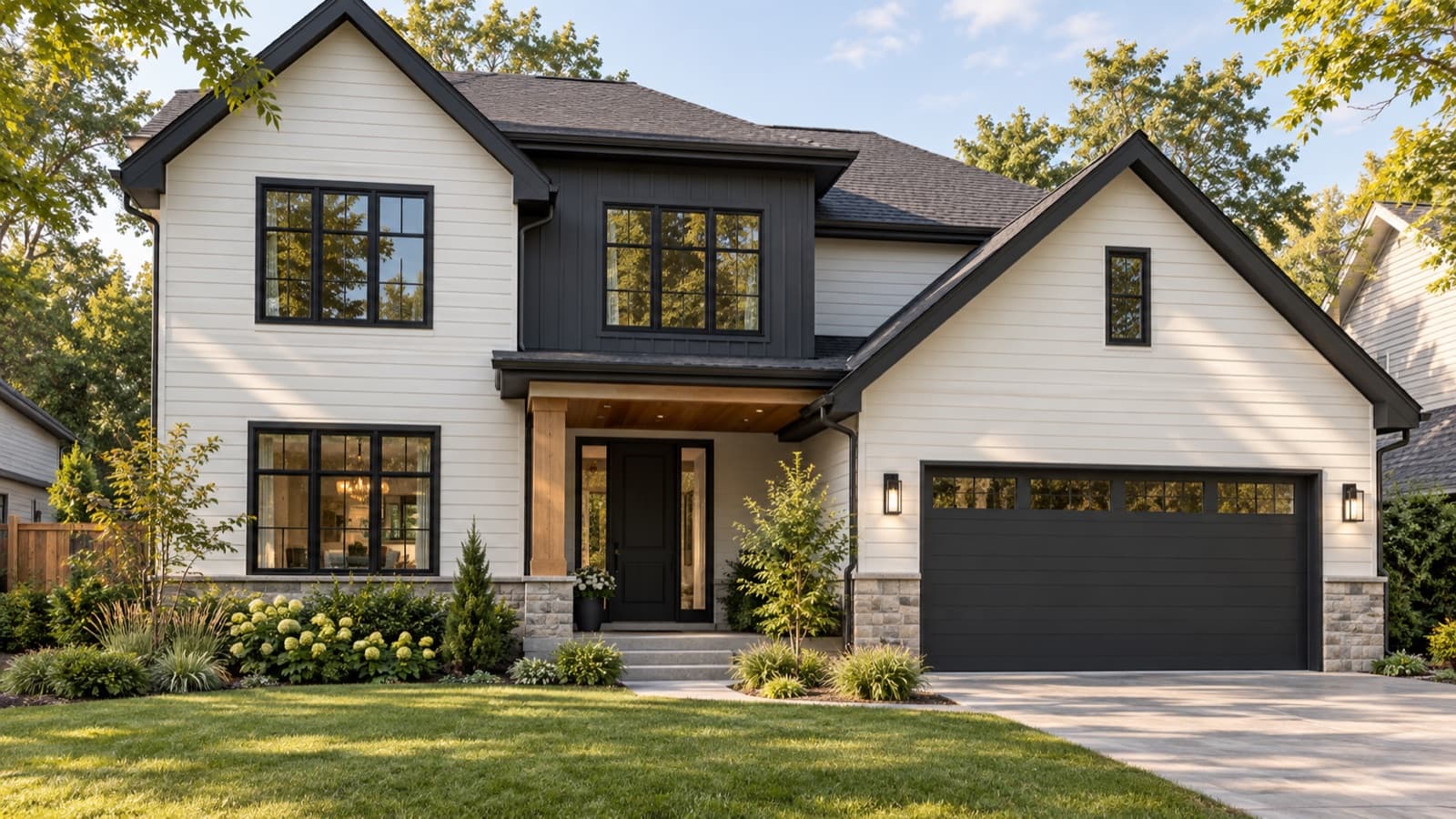
Siding is a 30-year decision, which makes colour the scariest part. The safe choices haven’t changed much, but what’s on new builds and renovations across London and the GTA in 2026 has shifted noticeably toward darker, warmer, and more textured exteriors. Here’s what’s current, what has staying power, and how to pick a colour you won’t regret in 2040.
What’s Trending in Ontario Right Now
- Charcoal, iron grey, and near-black. The dominant look on modern builds, usually with black windows and a warm wood or stone accent to keep it from feeling cold.
- Warm whites and creams. The reaction to a decade of grey. Off-white lap siding with black windows and a natural wood door is everywhere.
- Wood-look and warm neutrals. Cedar-tone fibre cement, engineered wood, and vinyl in caramel, walnut, and honey tones, often as an accent on gables or entries.
- Deep greens and navy. Forest green, olive, and navy as a full-house colour, especially on farmhouse and craftsman styles.
- Textured profiles. Board and batten, shakes, and mixed profiles matter as much as colour; a single flat lap in one colour is the look that reads dated.
The Classics That Never Date
If you want to be safe for 30 years: mid-grey, greige, soft white, and taupe with white or black trim. These have been on Ontario houses since before vinyl existed and will still look right when the current trends have moved on. Dark colours are also durable in taste terms; a charcoal house with white trim looked good in 1926 and looks good now.
Two-Tone and Mixed-Material Combinations
Dark body, light trim
Charcoal or navy siding, white or cream trim and soffit, black windows. Crisp and current.
Light body, dark accents
White or greige lap siding, black windows, black or wood door, black eaves. The most popular 2026 combination.
Board and batten gables over lap
Same colour in two profiles, or a slightly darker gable. Adds depth without adding a second colour.
Wood-tone accent
A neutral main colour with cedar-look siding on the entry, a gable, or a garage bump-out. Warm and hard to get wrong.
Keep it to three: a body colour, a trim colour, and one accent (door or feature material). Four or more looks busy from the street.
Pairing Siding With Existing Brick
Most Ontario siding jobs are partial: brick on the main floor, siding above or on the sides. The siding has to work with the brick, not fight it. Red brick pairs with charcoal, cream, sage, navy, and warm taupe. Brown brick pairs with cream, olive, charcoal, and warm grey. Buff and grey brick pairs with almost anything, including black and white. Avoid a siding colour that’s close to the brick but not quite the same; it reads as a mismatch. Either contrast clearly or pick the brick’s darkest tone.
A Word on Dark Colours and Vinyl
Dark siding absorbs heat. Standard vinyl can distort in full sun in charcoal or black, so manufacturers either restrict those colours, use heat-reflective pigments, or limit warranty coverage on dark shades. If you want a dark house, either choose a vinyl line specifically rated for dark colours, or go to fibre cement or engineered wood, which don’t soften. Ask to see the colour fade and heat-distortion terms in the warranty before you sign.
Read the Neighbourhood
Drive your street and the two beside it. If every house is beige and you go black, you’ll stand out, which you may want or may regret at resale. If the street is a mix, you have freedom. In a heritage district, colour may be governed by the district plan; check before ordering. And look at the roof: a brown roof limits you to warm siding colours, a black or grey roof opens everything up.
How to Choose Without Regret
- Get real samples, not brochure chips. Siding manufacturers supply 12-inch pieces; hold them against the brick and the roof in morning and evening light.
- Colours look lighter and brighter outside and on a large wall than on a sample. Go one shade darker than your instinct.
- Mock it up. Many manufacturers have online visualizers; a photo of your house with the colour applied is worth an hour.
- Choose the trim colour at the same time. White trim on a warm body colour can look blue; cream may be the better white.
- Think about the windows. If you’re replacing windows in the next five years, choose siding that works with both your current and future window colour.
Want to See Colours on Your Own House?
We bring full-size samples of vinyl, fibre cement, and engineered wood to your driveway and quote the combination you like in writing.