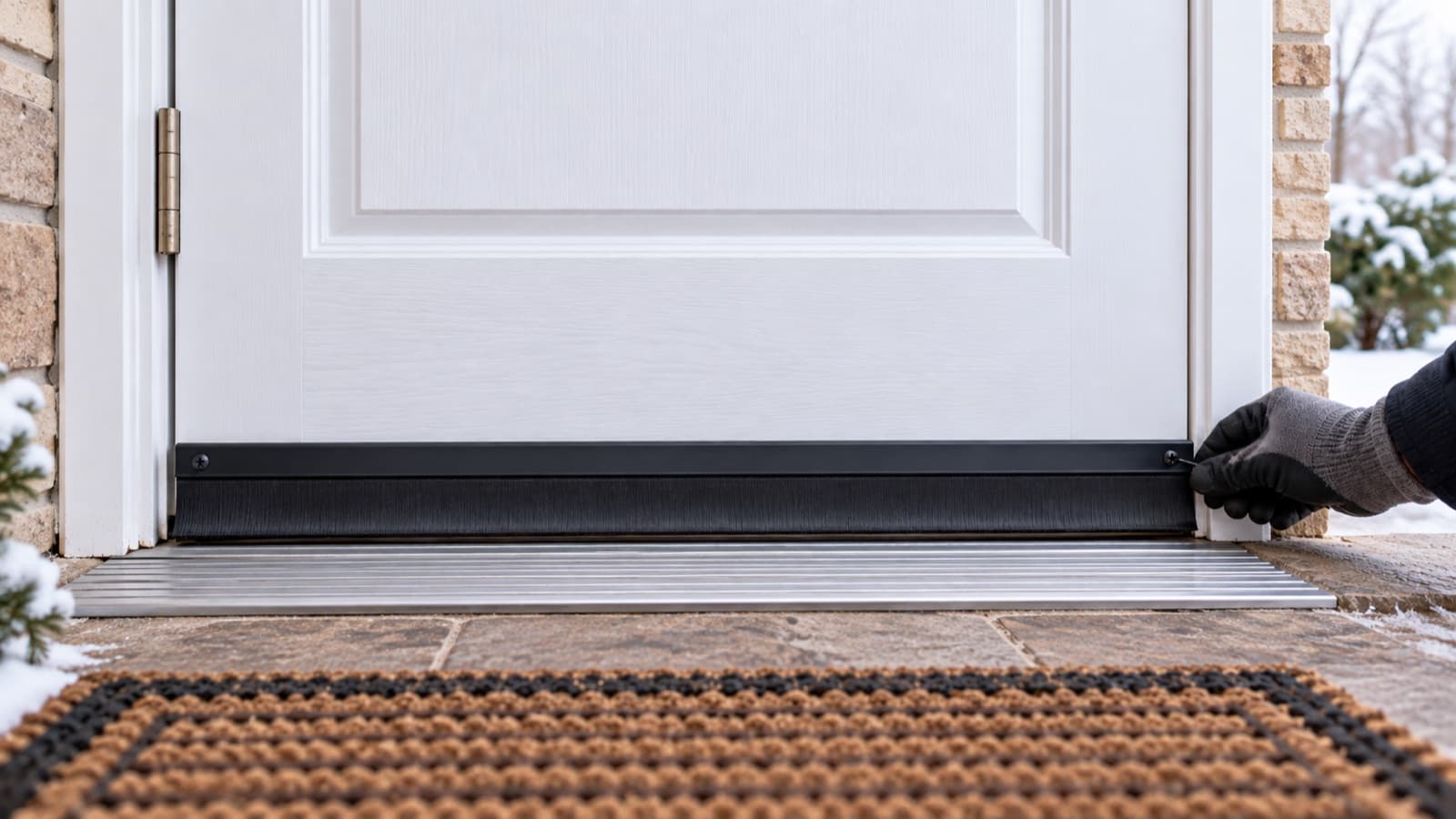
A cold draft at the front door doesn’t always mean you need a new door. Often it means a $15 sweep or an hour with a screwdriver. We sell doors for a living, and we’d still rather you try these fixes first, because a door that’s structurally sound and just badly adjusted is a waste of money to replace. Here’s how to diagnose the draft, fix what’s fixable, and recognize when replacement really is the answer.
Find the Draft
On a cold, windy day, close the door and run the back of your hand slowly around the entire perimeter, then along the bottom, then around any glass. A lit incense stick or a strip of tissue does the same job visibly. Also do the light test at night: turn off the hall light, have someone shine a flashlight around the outside of the closed door, and note where light comes through. And the paper test: close the door on a strip of paper at several points; if it pulls out with no resistance, the seal isn’t touching there.
The Bottom: Sweep and Threshold
Most door drafts come in at the bottom. The sweep is the strip on the bottom of the door; the threshold is the sill it seals against. Fixes, cheapest first:
- Adjust the threshold. Many steel and fibreglass door thresholds have four or five screws along the top that raise or lower the sill cap. A quarter turn at a time until the paper test resists everywhere.
- Replace the sweep. Slide-in or screw-on sweeps cost $10 to $30 and take 20 minutes. Match the type (fin, bulb, or brush) to the original.
- Replace the threshold cap or gasket. If the vinyl insert is cracked or flattened, the cap is usually replaceable on its own.
- Add a door shoe if the door was cut short at some point and no sweep can bridge the gap.
The Sides and Top: Weatherstripping
Modern doors use a compression weatherstrip in a kerf (slot) in the frame. It flattens, tears, and hardens over 10 to 15 years. Pull the old one out, take a piece to the hardware store to match the profile, and press the new one in. Cost is $20 to $40 for a door. On older wood frames with surface-nailed felt or foam, replace with a kerf-in or screw-on bronze or vinyl strip. Never rely on adhesive foam tape as a permanent fix; it lasts one winter.
Adjust the Door and Strike
If the seal is new but the paper test still fails on one side, the door isn’t closing square. Check:
- Hinge screws. Tighten them. Replace one screw per hinge with a 3-inch screw into the framing to pull a sagging door back up.
- Strike plate. If the latch barely catches and the door rattles, move or shim the strike plate so the door closes tight against the weatherstrip. A deadbolt that has to be forced is a sign the strike is misaligned.
- Hinge shims. A thin cardboard shim behind one hinge leaf changes the door’s angle and can close a gap at the top or bottom corner.
- Adjustable hinges. Many newer doors have hinges with a set screw that moves the door in or out toward the weatherstrip.
The Frame and Trim
Drafts that come from around the outside of the frame, behind the casing, mean the gap between the frame and the wall was never insulated or the caulking has failed. Inside: pull the casing, fill the gap with low-expansion foam or backer rod and sealant, reinstall. Outside: cut out cracked caulking between the brickmould and the brick or siding and recaulk with a quality exterior sealant. This is a two-hour job and fixes a surprising number of “bad door” complaints.
Glass and Sidelites
Cold radiating from a big door lite or sidelites isn’t a draft; it’s conduction through old glass. If the glass is single-pane or the sealed unit has fogged, the insert can often be replaced with a modern Low-E unit without replacing the door. Feel for actual air movement around the glass frame; if there is some, the glazing bead or gasket needs resealing.
Storm Doors
A storm door adds an air space and blocks wind, and on a drafty older door it makes a noticeable difference for a few hundred dollars. Two cautions: a storm door over a dark-coloured steel or fibreglass door in full sun can trap enough heat to damage the finish, and a storm door on a new, well-sealed door adds little. Best used on sound older doors, north and windy exposures, and where you want a screen in summer. Our storm door guide explains which types are safe over a new door.
When to Replace Instead
- The door or frame is rotted, rusted through, or delaminating. No adjustment fixes that.
- The door is warped or twisted so it can’t touch the weatherstrip on all sides at once.
- The frame is out of square from settling and the door binds at one corner and gaps at the other.
- It’s a hollow or uninsulated slab, single-pane glass, no thermal break, and you feel cold radiating even with a perfect seal.
- You’ve done the fixes above and the paper test still fails.
If you’re there, our steel vs. fibreglass guide and entry door buying guide will help. A new ENERGY STAR® certified door also qualifies for Ontario’s $100 per opening rebate when bundled with an energy assessment.
Tried the Fixes and Still Cold?
We'll look at the door and tell you honestly whether it can be adjusted or needs replacing. No commission, so no reason for us to say 'replace' unless it's true.