Two hardware upgrades come up on almost every door quote: a multi-point lock instead of a standard deadbolt, and a smart lock instead of a key. One is about security and seal; the other is about convenience. Both add cost, and both have specific Canadian-winter caveats. Here’s whether each is worth it for your door.
What a Multi-Point Lock Does
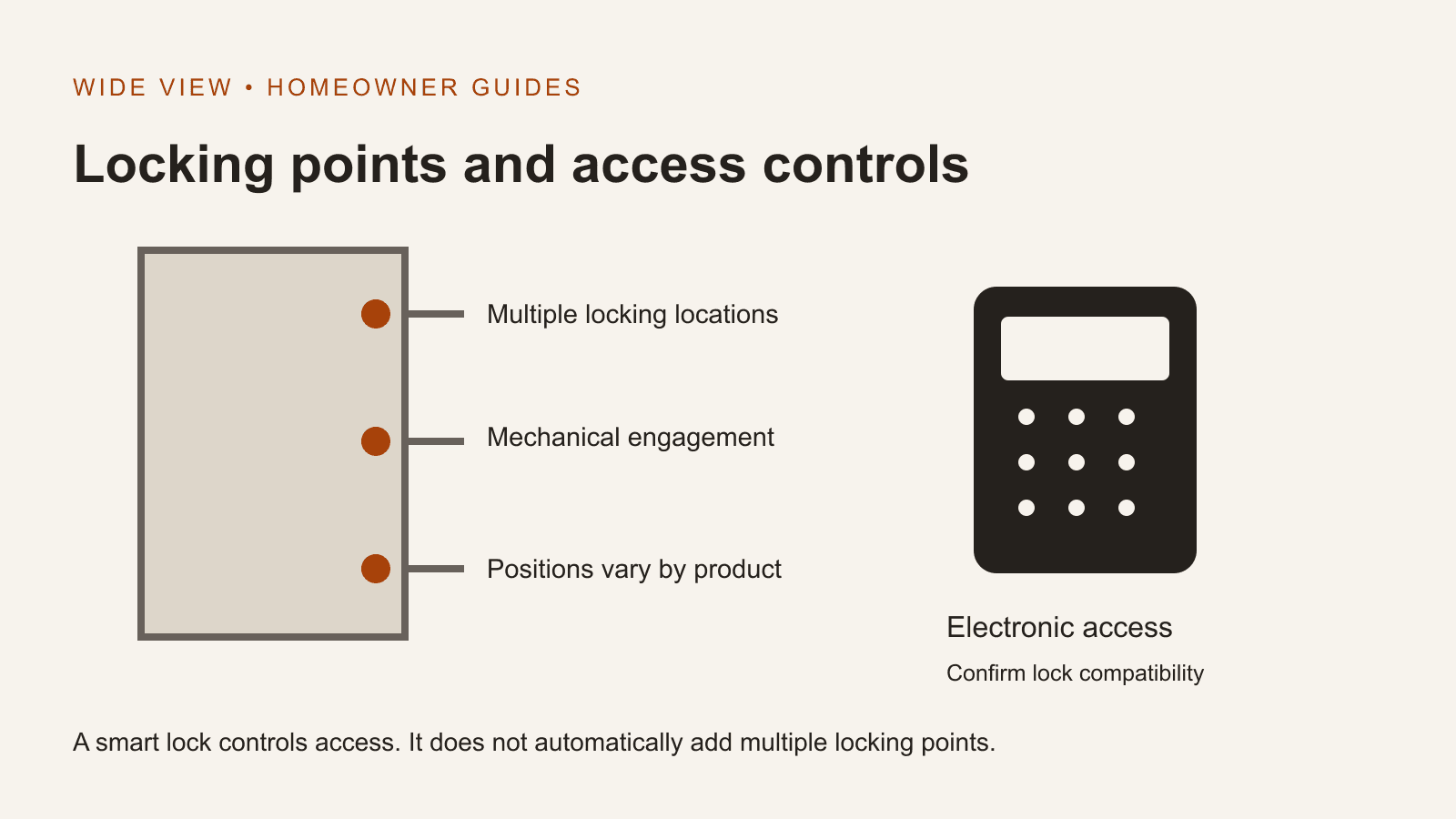
A standard door locks at one point: the deadbolt, roughly at hand height. A multi-point lock runs a steel rod inside the door edge and, when you lift the handle or turn the key, throws bolts or hooks at three or more points: top, middle, and bottom. The whole edge of the door is pinned to the frame.
Two benefits follow. Security: a kick or pry at the deadbolt can’t flex the door away from the frame at the top and bottom, which is how most forced entries succeed. Seal: pulling the door tight at three points compresses the weatherstripping evenly along its full height, so the door stays airtight as it ages and doesn’t warp at the corners. On a tall door, a door with glass, or a French or garden door, that second benefit is the one you feel every winter.
Is a Multi-Point Lock Worth It?
Cost: typically $300 to $700 more than a standard handle and deadbolt set on a new door, more for premium hardware. Retrofitting to an existing door is possible on some doors but usually not economical.
Worth it
Tall (8-foot) doors. French and garden doors. Doors on exposed north or west walls. Fibreglass doors with large lites. Anyone whose current door needs a shoulder to close in January.
Skip it
A standard 80-inch steel door under a sheltered porch with a good Grade 1 deadbolt and reinforced strike. Side and garage-to-house doors. Tight budgets where the money is better spent on the door slab itself.
Note that a multi-point lock is only as strong as the frame it locks into. Insist on a reinforced or composite frame and long screws into the studs.
Smart Locks: What’s Available
- Keypad deadbolts. A code replaces the key; most also keep a keyway. Simplest and most reliable.
- Bluetooth and Wi-Fi locks. Unlock from a phone, share codes with a cleaner or Airbnb guest, get a log of who came in. Wi-Fi models let you check the door from anywhere.
- Fingerprint locks. Fast, but readers can struggle with cold, wet, or gloved hands.
- Retrofit interior units. Replace only the inside thumb-turn, keep your existing exterior cylinder and keys. Easiest install, keeps the door’s look.
- Integrated multi-point smart handles. A motorized multi-point lock with a keypad or app. The premium option on new fibreglass doors.
Smart Locks and Canadian Winters
This is where most smart lock disappointments come from. Many consumer locks are rated to about −10°C on the exterior face. A front door in London or Toronto in January routinely sees −20°C or colder on the outside, and a north-facing door is colder still. Below the rating, keypads stop registering, screens freeze, and batteries sag until the motor won’t turn. What to look for:
- A published operating range to at least −30°C for the exterior unit.
- Lithium batteries (not alkaline), and expect to change them two to three times more often in winter.
- A mechanical keyway as a backup. Never buy a lock with no physical override.
- A physical keypad over a touchscreen, which works better with gloves and frost.
- The battery and electronics on the inside of the door, where it’s warm; the best designs put only a keypad outside.
Is a Smart Lock Worth It?
Cost: $150 to $400 for a good keypad or Wi-Fi deadbolt, $600 and up for integrated multi-point smart hardware. Worth it if you have kids coming home to an empty house, dog walkers, cleaners, or short-term guests, or if you’ve ever locked yourself out. Less compelling if everyone has keys and the door is on a cold, exposed elevation where reliability matters more than convenience. Security-wise, a quality smart deadbolt is as strong as a mechanical one; the risk is in cheap models with weak cylinders, not in the electronics.
Combining the Two
Yes, you can have both. Options range from a smart deadbolt fitted above a manual multi-point handle (the multi-point does the sealing, the smart lock does the locking) to fully motorized multi-point systems from the door manufacturers. The combined approach is the best-sealing, most convenient front door you can buy, at a hardware cost around $800 to $1,500.
Don’t Skip the Basics
No lock upgrade matters if the strike plate is held by 3/4-inch screws into a pine jamb. Whatever hardware you choose: a heavy strike plate with 3-inch screws into the framing, a reinforced frame, laminated or tempered glass in any lite, and a door that closes square. Our entry door guide covers the rest.
Upgrading Your Door Hardware?
We install multi-point and smart lock systems on new doors and will tell you honestly which is worth it for your exposure and your household.