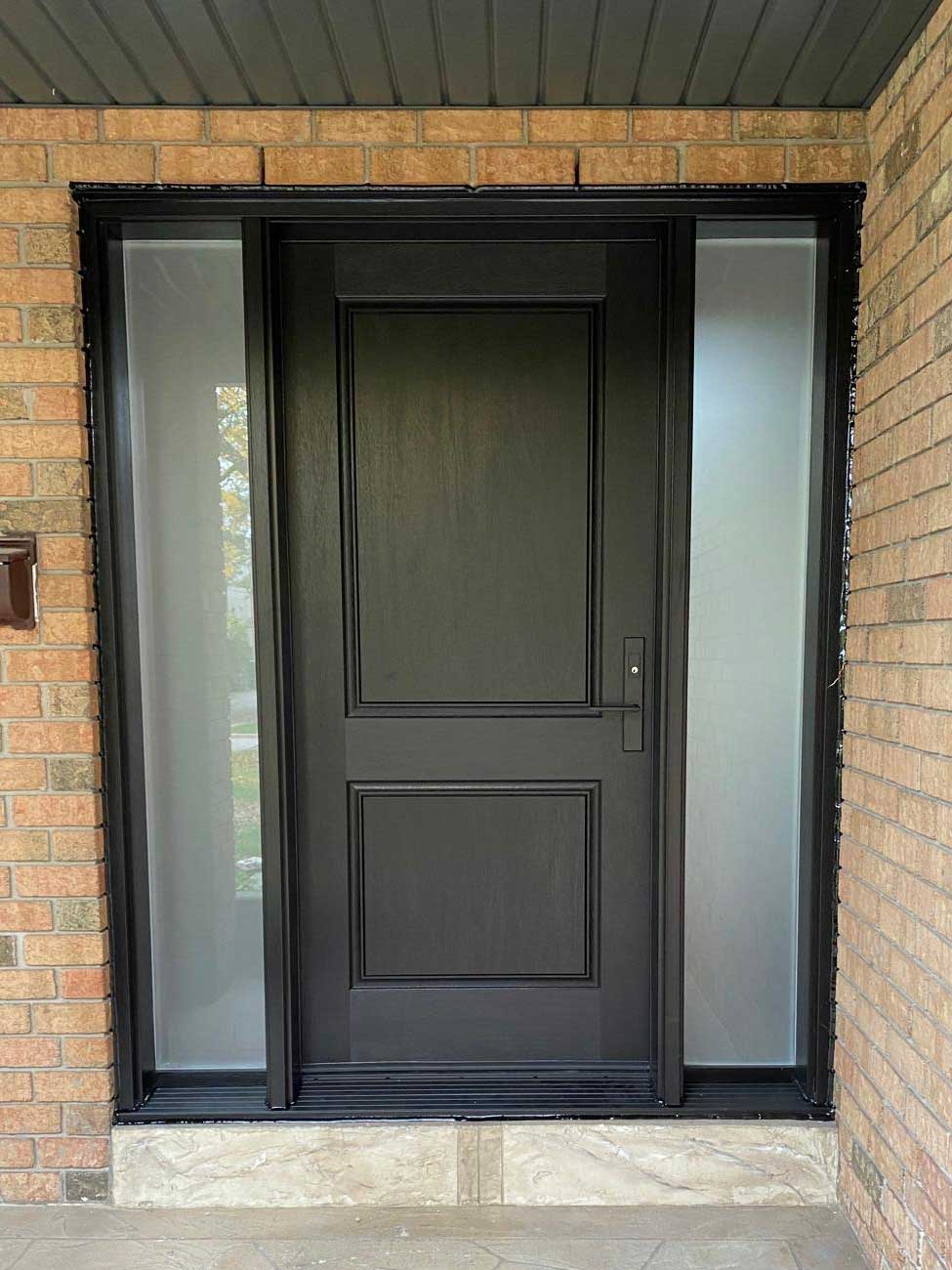
Nearly every entry door installed in Ontario today is steel or fibreglass. Both have insulated foam cores, both come in the same styles and glass options, and from ten feet away they can look identical. The differences show up in year five, in a February cold snap, and on the invoice. Here’s how they compare for a Canadian front door.
How Each Door Is Built
Steel doors have two galvanized steel skins, typically 24 to 22 gauge (lower is thicker), bonded to a polyurethane foam core with a wood or composite frame around the edges. Better doors use thicker steel, a thermal break between the skins so the cold outer face doesn’t conduct straight through to the inside, and composite rather than wood edge rails that can’t rot.
Fibreglass doors use moulded fibreglass-reinforced skins, smooth or embossed with a wood grain, over the same kind of foam core and composite frame. Premium doors have thicker skins and fully composite edges. Fibreglass is a poor conductor, so a thermal break isn’t needed.
Dents, Rust, Scratches, and Weather
Steel
Dents from a bike, a delivery cart, or a hockey puck, and dents are hard to repair invisibly. If the finish is scratched through to bare metal and left, it can rust, especially at the bottom where salt and slush sit. Conducts cold, so a door without a thermal break can frost on the inside in a cold snap. Very stable; won’t warp.
Fibreglass
Very resistant to denting and can’t rust. Scratches stay in the skin and can be touched up. Doesn’t conduct cold, so no interior frost. Doesn’t expand and contract much with temperature. Cheap thin-skinned fibreglass can crack under a hard impact in extreme cold, which is a reason to buy a quality door.
In Ontario specifically, the salt-and-slush zone at the bottom of a door is where steel shows its age first, and the interior frost line on an exposed north door is where homeowners notice the thermal difference. Fibreglass wins on both counts.
Insulation and ENERGY STAR
The foam core does most of the insulating in either door, so a solid steel door and a solid fibreglass door have similar core R-values, commonly in the R-5 to R-7 range. The differences are at the edges and the skin: steel without a thermal break bridges cold through the frame, and any glass insert lowers the whole-door rating a lot.
ENERGY STAR® certification in Canada applies the same threshold to doors as to windows: a U-factor of 1.22 W/m²·K or lower, or an Energy Rating of 34 or higher, plus air leakage no greater than 1.5 L/s/m². Both materials have plenty of certified models. As with windows, buy the label, not the material, and remember that a door’s real-world performance is mostly about the weatherstripping, the sweep, and how square the frame was installed. Certified doors also qualify for Ontario’s Home Renovation Savings Program rebate of $100 per opening when bundled with an energy assessment; see our 2026 rebate guide.
Security
Steel has the reputation, but a modern fibreglass door with a composite frame and a multi-point lock is just as hard to kick in. Forced entries almost never go through the door slab; they go through the frame and strike plate. What matters for either material:
- A reinforced strike plate with 3-inch screws into the wall framing, not the jamb.
- A Grade 1 or Grade 2 deadbolt, or a multi-point locking system that engages at the top, middle, and bottom.
- Laminated or tempered glass in any lite or sidelite, so breaking it doesn’t give access to the lock.
- A steel or composite-reinforced frame. A great door in a soft pine jamb is only as strong as the jamb.
Steel does have an edge where the door itself is the target, since a fibreglass skin can be punched through with enough effort. For a typical home, that’s not the realistic threat.
Appearance and Finish
Steel comes smooth, factory-primed or painted, in a range of panel designs and glass inserts. It gives a crisp, modern or traditional painted look and takes paint well if you want to change colour.
Fibreglass comes smooth or wood-grained. Grained fibreglass, stained to look like oak, mahogany, or fir, is the reason many people choose it: you get the look of a wood door without the maintenance, warping, or price. Smooth fibreglass painted black is currently the most popular front door in the GTA. Dark colours on a sun-facing steel door can get very hot and stress the finish; fibreglass handles dark colours better.
Maintenance
Both need a wipe-down and a look at the weatherstripping and sweep once a year. Steel needs any chips or scratches touched up promptly to prevent rust. Factory-painted steel typically wants repainting every 8 to 12 years depending on exposure. Fibreglass finishes, especially factory-applied ones, last longer, and stained fibreglass benefits from a fresh clear topcoat every 5 to 10 years on an exposed elevation.
Cost in Ontario
2026 Ontario pricing guides show a consistent pattern: steel is the budget option and fibreglass costs more, with the GTA running 10 to 20 percent above the rest of the province.
| Installed, single door, standard size | Steel | Fibreglass |
|---|---|---|
| Ontario, typical range | $1,200–$2,500 | $2,000–$4,500 |
| With one or two sidelites | $2,500–$4,500 | $3,500–$7,000 |
| Premium / custom / double doors | $4,000+ | $6,000–$12,000+ |
Installation alone typically adds $600 to $1,000 in the GTA for a straightforward swap, more if the frame, threshold, or brickmould needs rebuilding. Big-box steel doors can be had for less than these ranges, but they’re usually thinner gauge, without a thermal break, and with a wood edge that rots; that’s where the dent-and-rust reputation comes from.
The Overhang Test
The simplest way to decide: look at what’s above your door.
- Deep porch or overhang, door faces north or east: steel is a fine choice and the money saved can go into a better lock and sidelites.
- Little or no overhang, door faces south or west, or it takes wind and driven rain: fibreglass. It won’t rust at the bottom, won’t frost inside, and the finish will hold up to sun.
- Any door with a dark colour in full sun: fibreglass.
Which Should You Choose?
| Factor | Steel | Fibreglass |
|---|---|---|
| Cost | Lower | Higher |
| Dent resistance | Fair | Excellent |
| Rust | Possible if scratched | Never |
| Cold conduction | Needs thermal break | Naturally low |
| Wood-grain look | No | Yes |
| Dark colours in sun | Finish stress | Handles well |
| Security | Excellent | Excellent with good frame and lock |
| Warranty (typical) | 10–20 years, often limited | Often limited lifetime on slab |
| Lifespan | 20–30 years | 30–50 years |
For most Ontario front doors, especially exposed ones, fibreglass is the better long-term buy and the extra cost is modest against the life of the door. For a sheltered entry, a side door, or a garage-to-house door, a quality thermally broken steel door is excellent value. For more on styles, glass, and hardware, see our entry door buying guide.
Ready to Replace Your Front Door?
We’ll show you steel and fibreglass options side by side, explain what suits your exposure, and quote in writing. Serving London, Mississauga, Oakville, and the GTA.