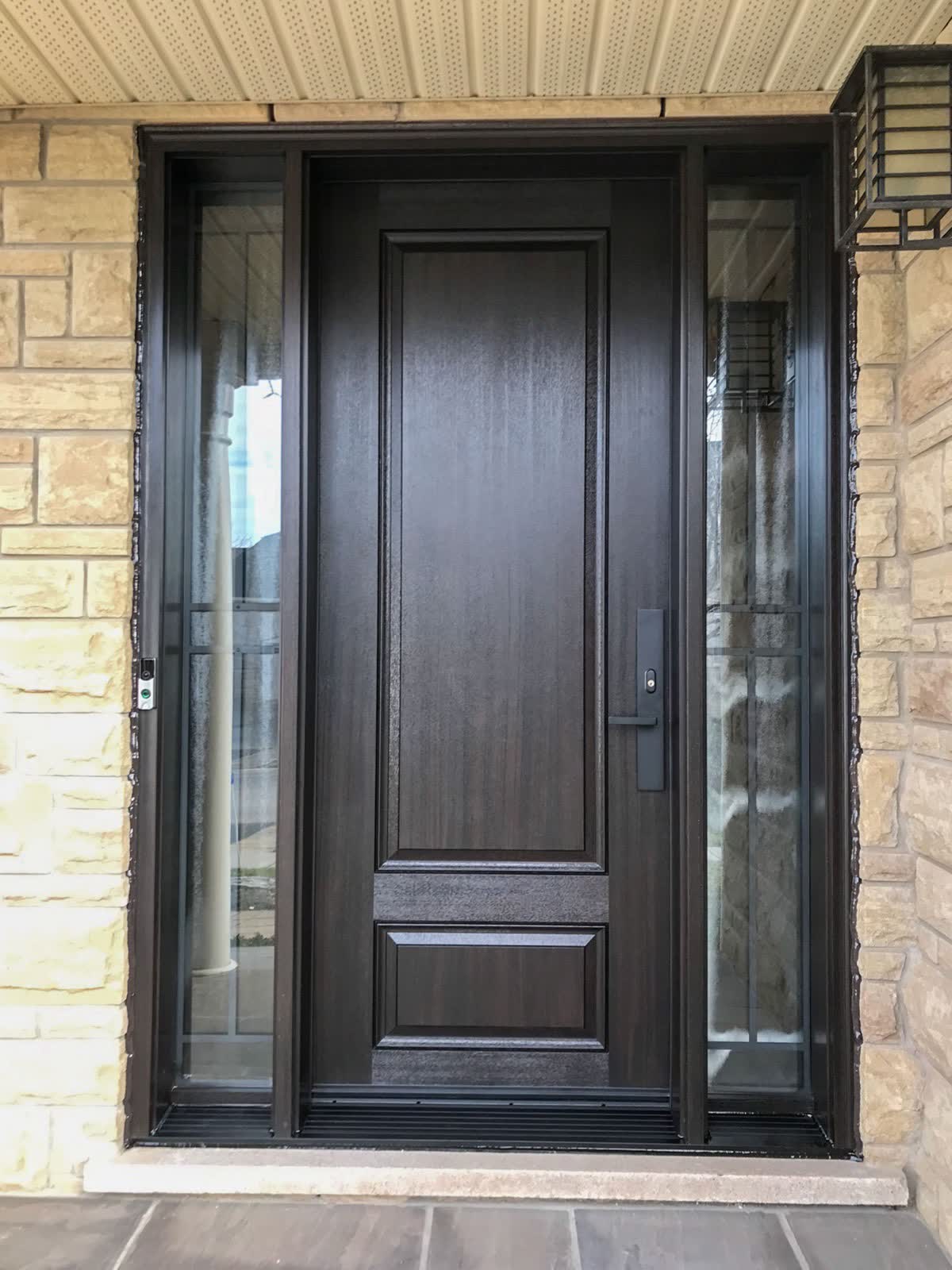
Your front door does a lot of heavy lifting. It’s the first thing visitors notice, the last line of defence between your family and the outside world, and one of the biggest factors in how well your home holds heat during an Ontario winter. When it’s time to replace it, you want to get it right.
With over 20 years of installing entry doors across Mississauga, Oakville, and now London, Ontario, we’ve helped homeowners navigate the options and find a door that checks every box — security, style, and energy performance. Here’s what you need to know.
Security: Your Front Door Is Your First Line of Defence
It might surprise you to learn that a significant number of residential break-ins start right at the front door. A weak slab, a flimsy frame, or a basic single-point lock can be defeated in seconds. The good news is that modern entry doors are built to fight back.
Door Material Matters
The material of your door slab is the foundation of your home’s security. Not all materials are created equal:
Steel
The strongest option on the market. Metal skin over a reinforced frame with an insulated core. Resists forced entry, won’t warp or crack, and can last 30+ years. Most secure & budget-friendly.
Fiberglass
Excellent balance of strength, durability, and aesthetics. Dent-resistant, low-maintenance, and available in convincing wood-grain finishes. Best all-around performer.
Wood
Timeless and beautiful, but requires regular painting or staining. Solid wood provides decent natural insulation but can swell, shrink, and warp over time. Best for classic aesthetics.
Locks and Hardware
A strong door deserves strong hardware. Here’s what to look for:
Multi-point locking systems are the gold standard. Unlike a standard single deadbolt, multi-point locks secure the door at three or more points along the frame — typically the top, bottom, and latch side. This distributes force across the entire door, making it significantly harder to kick in.
Grade 1 deadbolts with reinforced strike plates are essential. Make sure the strike plate is secured with screws long enough to reach the structural framing behind the door jamb — not just the thin trim around it.
Smart locks are increasingly popular, offering keyless convenience through fingerprint readers, keypad codes, or smartphone access. Look for models rated for cold temperatures if you’re in Ontario, since not all electronics perform well in our winters.
Glass Inserts and Security
Many homeowners love the look of decorative glass in their entry door, and you don’t have to sacrifice security for style. If your door includes glass panels, look for tempered or laminated glass, which is far more resistant to impact than standard glass. Even if cracked, laminated glass holds together, preventing someone from reaching through to unlock the door from inside.
For extra peace of mind, wrought iron or decorative grille inserts add both visual appeal and a physical barrier.
Style: Making a Strong First Impression
Your entry door is one of the biggest design statements your home makes. It sets the tone for everything behind it, and the right door can dramatically boost your curb appeal and even your property’s resale value. In fact, industry data suggests a new entry door can return up to 70–90% of its cost at resale.
Colour Trends
Bold, rich door colours are a major trend right now. Deep blues, forest greens, and striking matte black are all popular choices that create a dramatic contrast against lighter exteriors. For homeowners who prefer a more understated look, warm earth tones — think chocolate, caramel, and warm taupe — are replacing the cooler greys that dominated in recent years.
Modern paint technology means today’s factory-applied finishes are more fade-resistant and durable than ever, so your door will hold its colour through years of Ontario sun, snow, and rain.
Design Styles to Consider
Modern & Minimalist
Clean lines, flat panels, smooth surfaces, and slim sightlines. Steel and fiberglass doors with narrow vertical glass inserts fit this aesthetic perfectly.
Craftsman
A timeless choice with strong, geometric lines and a solid, grounded feel. Works beautifully on both traditional and updated homes.
Farmhouse-Inspired
Combining the warmth of traditional materials with clean, contemporary lines. Often features wood-grain fiberglass finishes with simple glass lites.
Grand & Oversized
Taller, wider doors that make a statement. Double doors and 8-foot single doors create an impressive entrance and flood your foyer with natural light.
Sidelites and Transoms
Adding sidelites (narrow glass panels flanking the door) or a transom (a window above the door) is one of the most effective ways to brighten a dark entryway without sacrificing wall space. These additions let natural light pour into your front hall and make your entrance feel more open and inviting. Just make sure any glass includes Low-E coatings and is properly insulated to maintain energy efficiency.
Energy Efficiency: Keeping the Cold Out and Your Money In
Ontario homeowners know that heating costs can be brutal. According to Natural Resources Canada, up to 25% of a home’s heating and cooling energy can be lost through poorly insulated windows, doors, and skylights. Your entry door is part of that equation, and an energy-efficient replacement can make a real difference in your comfort and your utility bills.
What Makes a Door Energy Efficient?
An energy-efficient entry door is more than just a thick slab. It’s a system — the door itself, the frame, the weatherstripping, the glass (if any), and the installation all work together. Here are the key components:
Insulated core — The best steel and fiberglass doors feature a high-density polyurethane foam core that provides strong thermal resistance. Quality insulated doors can achieve an R-value of 5 to 7.
Weatherstripping — The seal around the perimeter of the door that blocks air infiltration. Compression-style and magnetic weatherstripping provide the tightest seals. A good door sweep at the bottom is equally important.
Low-E glass — If your door has glass inserts, make sure they include Low-E coatings. Triple-pane glass with argon gas fill is the premium option for maximum insulation and noise reduction.
Thermal breaks — Especially important for steel doors, which naturally conduct heat. A thermal break is an insulating barrier built into the frame that prevents cold from transferring through the metal.
Understanding Canadian Energy Ratings
In Canada, doors are tested using the CSA A440.2 standard and rated on several key metrics:
Energy Rating (ER) — Canada’s unique overall score that balances heat loss, solar heat gain, and air leakage into a single number. The higher the ER, the better. For ENERGY STAR certification, a door needs an ER of 34 or higher.
U-Factor — Measures the rate of heat transfer. Lower is better. For ENERGY STAR certification in Canada, you want a U-factor of 1.22 W/m²K or below.
R-Value — Measures resistance to heat flow. Higher is better. While not part of the official ENERGY STAR label, it’s a useful number for comparing insulation performance.
Look for the ENERGY STAR label on any door you’re considering. It’s your assurance that the product has been independently tested and certified to meet strict Canadian energy performance standards.
Ontario Rebates for Entry Doors
Just like with windows, Ontario homeowners can take advantage of rebate programs when upgrading to energy-efficient entry doors.
The Home Renovation Savings Program, delivered through Save on Energy and Enbridge Gas with Ontario government backing, offers rebates on eligible energy-efficient home improvements. Check the current official terms before starting work, as measures and funding can change.
To qualify, your new doors must be ENERGY STAR certified and installed by a licensed contractor. You’ll need a home energy assessment before and after the work. The separate federal Canada Greener Homes Loan is closed to new applicants because its funding is fully committed. See our rebate guide for the distinction between the provincial rebate and the closed federal loan.
Signs It’s Time to Replace Your Entry Door
Not sure if your current door needs replacing? Here are some common red flags:
- Visible drafts or cold air around the edges, especially in winter
- Difficulty opening or closing the door smoothly — a sign of warping or settling
- Daylight visible around the frame when the door is closed
- Peeling, cracking, or rotting on the door surface or frame
- Condensation or frost forming on the interior side of the door
- Increased outside noise making its way through
- Outdated locks that no longer feel secure
If any of these sound familiar, a new entry door isn’t just an upgrade — it’s a necessity.
Why Choose Wide View Contracting for Your Entry Door?
Your entry door is only as good as its installation. An improperly installed door — even a premium one — can leak air, fail to seal properly, and underperform from day one. That’s why who installs your door matters just as much as which door you choose.
At Wide View Contracting, we’ve been supplying and installing entry doors for over 20 years across Mississauga, Oakville, and now London, Ontario. Here’s what you can expect:
- No commission, no pressure. We’ll walk you through your options honestly and help you find what’s right for your home and budget.
- Protection first. Before work begins, our team ensures your home and belongings are protected and the work area is safe.
- Professional from start to finish. We deliver a level of professionalism that gives you peace of mind throughout the entire project.
- Post-project cleanup. When we’re done, it’ll be like we were never there.
- Fully certified, insured, and WSIB-covered. Your home and our workers are fully protected.
Our business is built entirely on referrals from satisfied customers — and we plan to keep it that way.
Ready to Upgrade Your Entry Door?
Whether you’re looking for better security, a fresh new look, or lower energy bills, the right entry door can deliver all three. And with Ontario rebates still available, there’s no better time to make the investment.