Your siding isn’t something you think about every day. It does its job quietly — protecting your home from rain, snow, wind, and temperature extremes — and most homeowners don’t give it much attention until something goes visibly wrong.
The problem is that siding doesn’t fail all at once. It deteriorates gradually. A small crack here, a loose panel there, a bit of fading that you write off as normal aging. By the time the damage becomes obvious, moisture may have already been working its way into your walls for months or even years.
Ontario’s climate makes this worse. Our freeze-thaw cycles, heavy snow loads, intense UV exposure in summer, and lake-effect humidity put constant stress on exterior cladding. What might last 40 years in a milder climate may only hold up for 20 to 25 in southern Ontario.
After more than 20 years of replacing siding on homes across Mississauga, Oakville, and London, Ontario, we’ve learned to spot the warning signs early. Here are the ones every homeowner should know.
1. Cracking, Warping, or Buckling
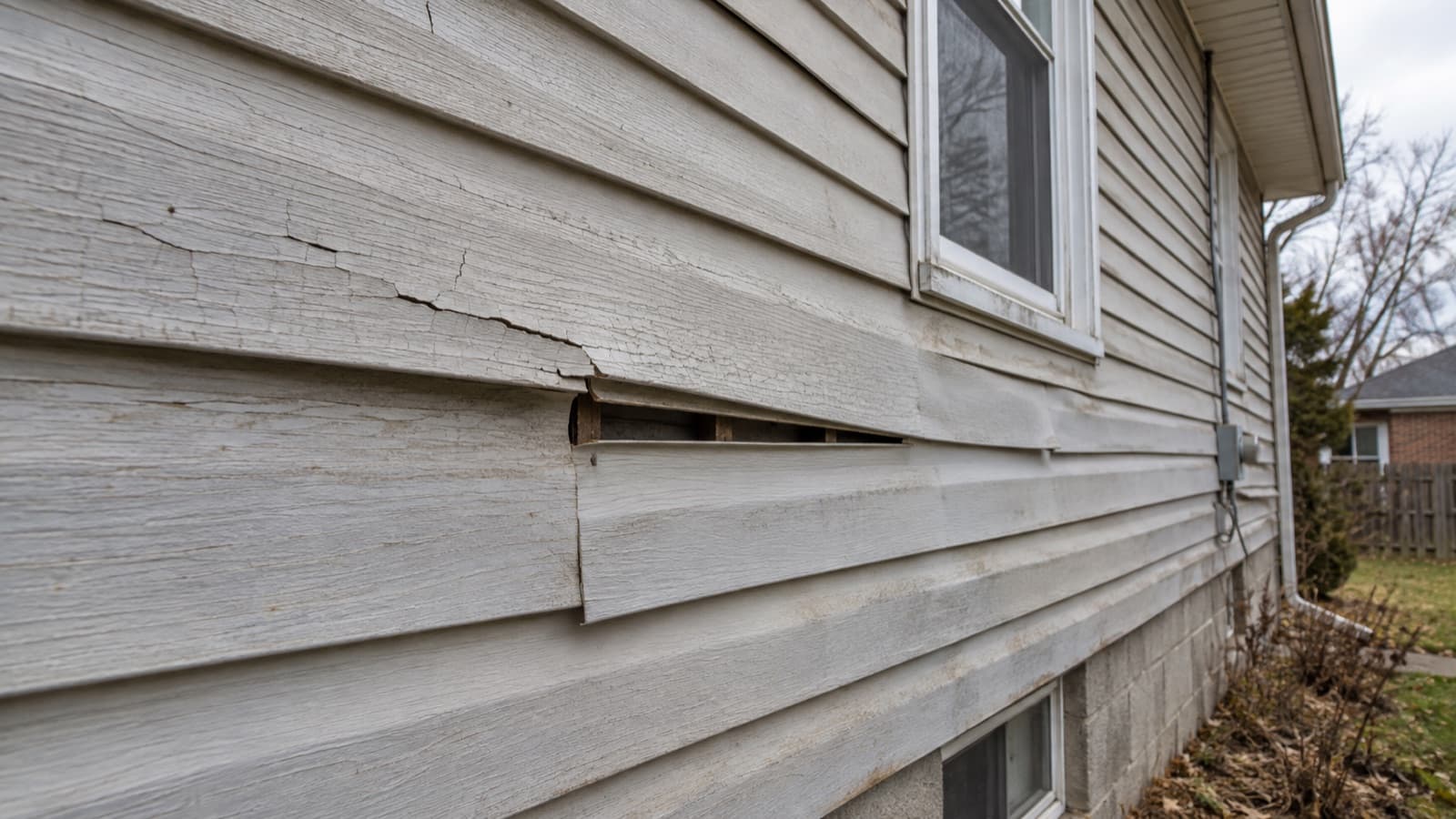
Walk around your home and take a close look at the siding — from the foundation all the way up. If you see panels that are cracked, warped, buckled, or pulling away from the wall, that’s more than a cosmetic issue.
Cracks create openings for water to get behind the siding. In Ontario, where temperatures regularly swing from well below freezing to above 30°C, any trapped moisture will expand and contract with each freeze-thaw cycle — widening the cracks and accelerating the damage.
Warping and buckling usually indicate one of two things: moisture has gotten behind the panels and is pushing them outward, or the siding has been exposed to extreme heat (common on south- and west-facing walls in summer) and has deformed. Either way, the panels can no longer lie flat against the wall, which compromises the entire weather barrier.
A single cracked panel can sometimes be replaced individually. But if you’re seeing cracking or warping in multiple areas, the siding as a whole is likely reaching the end of its useful life.
2. Rot, Soft Spots, or Crumbling
This one is most common with wood siding, but it can also affect engineered wood or any siding where moisture has been trapped behind the panels for an extended period.
Test your siding by pressing firmly with your finger or the handle of a screwdriver. If the material gives way, feels spongy, or crumbles, rot has already set in. This is a serious problem because rot doesn’t stay on the surface — it spreads into the sheathing and framing behind the siding, potentially causing structural damage that’s far more expensive to repair than the siding itself.
In Ontario, rot tends to develop in areas where moisture lingers longest: near the foundation, around window and door frames, under eavestroughs that overflow, and on walls that don’t get much direct sunlight. If you find soft spots in any of these areas, don’t wait. The longer you leave it, the more extensive (and costly) the repairs become.
3. Bubbling or Blistering
Bubbles or blisters on your siding are a clear sign that moisture has become trapped between the siding and the wall beneath. Since siding’s primary job is to keep water out, this tells you the material has failed in the one area where it matters most.
Bubbling can result from failing caulking, deteriorated weather barriers, or panels that were improperly installed without adequate ventilation behind them. In Ontario’s climate, where we get heavy rain in spring and fall, ice damming in winter, and humidity in summer, even small gaps in the weather barrier can lead to significant moisture accumulation over time.
If you see blistering on your siding, there’s a good chance moisture damage is already developing behind it. Have it inspected as soon as possible.
4. Mould, Mildew, or Fungal Growth
Finding mould or mildew on your siding — particularly near the seams, around the foundation, or in areas that stay damp and shaded — is a sign that moisture is present where it shouldn’t be.
A small amount of surface mildew on the north side of a house can sometimes be cleaned off and is relatively normal. But widespread growth, recurring mould in the same spots after cleaning, or fungal growth that appears to be coming from behind the siding (rather than sitting on the surface) indicates a deeper moisture problem.
Mould behind siding can spread to the wall sheathing and even into the interior of your home, creating both structural and health concerns. If you’re seeing persistent mould growth, it’s worth having a professional assess whether the siding and the weather barrier behind it need to be replaced.
5. Fading and Discolouration
All siding fades over time. Years of UV exposure gradually break down the surface colour. A bit of mellowing is normal and expected.
But when fading becomes severe — when the colour is dramatically different on sun-exposed walls versus shaded walls, or when the siding looks washed out and tired from the curb — it’s a sign that the material’s protective properties are diminishing along with its appearance. The same UV damage that fades the colour is also degrading the material’s ability to resist moisture and impact.
Severe fading is especially common on older vinyl siding (particularly dark colours from previous generations of product, before colour-lock technology became standard) and on painted wood siding that hasn’t been maintained. If your siding has reached this stage, repainting may help temporarily — but the underlying material may already be compromised.
6. Peeling, Chipping, or Flaking Paint
If your siding requires paint (wood or fiber cement), there’s an expected repainting cycle — typically every 8 to 10 years for most homes. If you’re finding yourself needing to repaint every 3 to 5 years because the paint keeps peeling, chipping, or blistering, the problem likely isn’t the paint.
Paint failure that happens faster than it should usually means moisture is migrating through or behind the siding, pushing the paint off from the inside. It can also indicate that the substrate (the siding material itself) has deteriorated to the point where it can no longer hold paint properly.
One thing to check: if you’re also seeing peeling paint or wallpaper on interior walls — especially near exterior walls — that could be a sign that moisture is penetrating all the way through the siding and into your wall cavities.
7. Loose or Missing Panels
Siding that’s come loose, pulled away from the wall, or gone missing entirely (often after a storm) leaves your home’s sheathing and insulation exposed to the elements. Even a small gap can let in wind-driven rain, pests, and cold air.
In Ontario, where winter storms can bring high winds and ice, loose panels are especially vulnerable. A panel that’s been loosened by one storm will often come off entirely in the next one. And every moment it’s loose, moisture is finding its way into your wall.
Individual panels can often be resecured or replaced. But if panels are coming loose in multiple areas, it usually means the fasteners, the substrate they’re attached to, or both have deteriorated — which points to a broader replacement.
8. Rising Energy Bills
If your heating or cooling costs have been climbing and you’ve already ruled out other common causes — leaky windows, inadequate attic insulation, aging furnace — your siding may be the culprit.
Siding that’s cracked, warped, loose, or missing creates gaps in your home’s thermal envelope. Cold air infiltrates in winter, conditioned air escapes in summer, and your HVAC system has to work harder to maintain a comfortable temperature.
This is especially noticeable in older homes with original siding that was installed without a proper weather barrier or exterior insulation. Modern siding systems, particularly insulated vinyl or fiber cement installed over rigid foam, can make a dramatic difference in energy efficiency.
9. Pest Damage or Infestation
If insects or rodents have been getting into your walls, your siding may be part of the problem. Damaged, rotting, or gaps in siding give pests a direct route into your home’s structure.
Woodpeckers can cause visible damage to wood siding. Carpenter ants and termites can burrow into wood and engineered wood products. Mice and other small rodents can squeeze through surprisingly small openings in damaged or poorly sealed siding.
If you’ve dealt with recurring pest problems and the exterminator can’t seem to solve it permanently, check your siding. The root cause may be gaps or damage that keep giving pests a way back in.
10. Your Siding Is Simply Old
Even well-maintained siding doesn’t last forever. Here are general lifespan expectations for common materials in Ontario’s climate:
Vinyl siding: 20 to 40 years, depending on quality and sun exposure. Cheaper grades installed in the 1990s and early 2000s may already be at or past their useful life.
Aluminum siding: 25 to 40 years. Common on Ontario homes built in the 1960s through 1980s. If yours is original to the house, it’s likely overdue.
Wood siding (cedar): 20 to 40 years with regular maintenance. Without it, as few as 10 to 15 years in Ontario’s climate.
Fiber cement: 50+ years. If you have fiber cement siding, it’s likely still in good shape unless it was damaged or improperly installed.
Engineered wood: 25 to 40 years depending on the brand and maintenance.
If your siding is approaching or has passed these milestones, it’s worth having a professional assessment — even if everything looks fine from the street. Problems often develop behind the siding where they’re invisible until they’ve caused real damage.
Repair or Replace? How to Decide
Not every problem means you need to re-side your entire home. Here’s a general framework:
Repair Makes Sense When
- The damage is isolated to a small area (a few panels or one section of wall)
- The rest of the siding is in good condition and well within its expected lifespan
- The damage is cosmetic rather than structural
- The same product is still available for a colour and style match
Replacement Makes Sense When
- Multiple areas show damage, wear, or failure
- You’re repairing the same problems repeatedly
- The siding is past or nearing the end of its expected lifespan
- Moisture damage has spread behind the siding
- You’re already planning to replace windows or doors (bundling saves money)
- Rising energy costs trace back to the exterior envelope
- Cumulative repair costs are approaching replacement cost
What to Look for in New Siding
If it’s time to replace, here are the key things to consider for an Ontario home:
Climate performance: Choose a material rated for freeze-thaw cycles, moisture resistance, and UV stability. Vinyl, insulated vinyl, and fiber cement are the strongest performers in our climate.
Energy efficiency: Adding rigid foam insulation behind new siding is one of the most impactful upgrades you can make. It improves your home’s R-value, reduces drafts, and can help you qualify for Ontario rebate programs.
Quality over price: The cheapest siding option isn’t always the best value. A slightly higher upfront investment in better materials often means fewer repairs, longer lifespan, and lower energy costs over time.
Professional installation: This matters as much as the material. Siding that’s improperly installed — without correct weather barriers, flashing, or expansion gaps — will fail prematurely regardless of how good the product is. Read our take on why your choice of installer matters.
Ontario Rebates for Siding Projects
If your siding replacement includes exterior insulation upgrades, you may qualify for rebates through Ontario’s Home Renovation Savings Program. The program lists up to $7,700 for eligible bundled upgrades; confirm the current measure requirements and timing before work starts.
You’ll typically need a pre-retrofit energy audit to establish a baseline and a post-retrofit audit to confirm the improvements. Adding rigid foam insulation behind new siding is one of the upgrades that can qualify, especially when combined with other measures like attic insulation or window replacement.
If you’re considering windows and doors alongside siding, doing everything together is both more cost-effective and better for your home’s overall performance. The flashing, weather barriers, and insulation all integrate properly when the work is done as one coordinated project — and you’re likely to qualify for higher total rebate amounts.
The Weekend Walk-Around
You don’t need to be a contractor to spot most of these warning signs. Pick a dry day and spend 20 minutes walking slowly around your home. Look at the siding from the street, then get up close. Here’s what to check:
- Look for: Cracks, chips, warping, buckling, loose or missing panels, gaps at seams and around windows and doors.
- Touch: Press on the siding in several spots, especially near the foundation and around windows. It should feel solid, not soft or spongy.
- Look down: Check the base of the walls where the siding meets the foundation. This is where water damage, rot, and pest entry are most common.
- Look for stains: Water stains, discolouration, or streaking can indicate moisture running behind the siding.
- Check the shade: North-facing walls and areas behind bushes or landscaping are prone to mould and moisture issues. Pull back any vegetation that’s touching the siding and look carefully.
- Go inside: Check interior walls that back onto exterior walls. Look for peeling paint, wallpaper bubbling, water stains, or a musty smell — all potential signs of moisture penetrating through the siding.
If you spot any of the warning signs we’ve discussed, don’t ignore them. The earlier you catch siding problems, the less expensive they are to address — and the less likely they are to cause damage to the structure of your home.
Let’s Take a Look Together
If you’re seeing some of these signs and you’re not sure whether it’s time to repair or replace, we’re happy to come take a look. We’ll give you an honest assessment — if your siding has a few more years left, we’ll tell you. If it’s time to replace, we’ll walk you through your options so you can make an informed decision. No commission and no pressure.