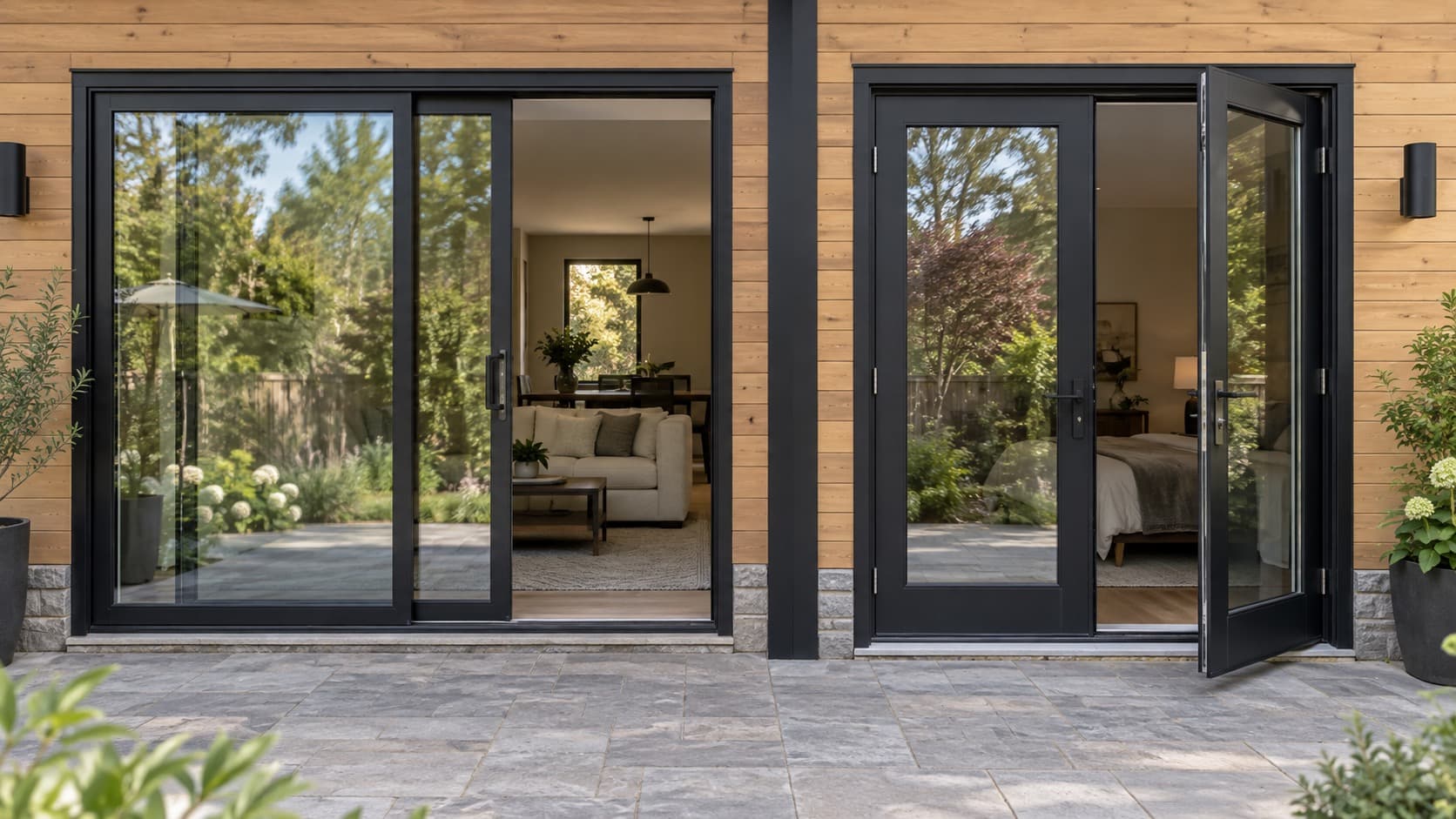
Few upgrades change the feel of a home as dramatically as a new patio door. Done right, it floods your living space with natural light, connects your indoor and outdoor areas, and can make even a modest room feel twice as large.
But the first decision most homeowners face is a fundamental one: sliding or hinged?
Both styles have loyal fans, and both have evolved significantly in the last decade. Today’s sliding doors are nothing like the drafty, wobbly sliders from the 1990s, and modern hinged (French) patio doors offer far better energy performance than their predecessors. The right choice depends less on which type is “better” and more on which type is better for your home, your space, and how you live.
After installing patio doors in homes across Mississauga, Oakville, and London, Ontario for more than 20 years, we’ve helped homeowners work through this exact decision hundreds of times. Here’s what we think matters most.
The Two Main Types (Plus a Third Worth Knowing About)
Before diving into the comparison, let’s make sure we’re speaking the same language.
Sliding Patio Doors
Sliding doors consist of two or more large glass panels set in a frame, with at least one panel gliding horizontally along a track. One panel stays fixed while the other slides open and closed. They’re sometimes called gliding doors or patio sliders.
Standard configurations include two-panel (the most common), three-panel, and four-panel designs. The more panels, the wider the opening and the more glass — which means more light and a broader view of your backyard.
There’s also a hybrid worth mentioning: the sliding French door, which combines the track-based operation of a slider with the wider stiles and decorative detailing of a French door. It gives you a more traditional look without needing swing clearance.
Hinged (French) Patio Doors
Hinged patio doors are attached to the frame by hinges on one or both sides and swing open — either inward into your home or outward onto your deck or patio. When people say “French doors,” they’re usually referring to a double-hinged patio door where both panels swing open from the centre.
Hinged doors come in several configurations: single-panel (one operable door with one fixed sidelight), double (both panels swing), and with optional sidelights or transoms above for additional glass and light.
Bifold Patio Doors
Bifold (or accordion-style) doors are a third option that’s become increasingly popular. Multiple panels fold and stack to one side, creating a dramatically wide, unobstructed opening.
Bifolds are stunning, but they’re also the most expensive option and aren’t practical for every home or layout. We’ll focus mainly on sliding vs. hinged in this guide, since those are the two choices most Ontario homeowners are deciding between — but if bifolds are on your radar, we’re happy to discuss them.
Space: The Factor That Often Decides Everything
If there’s one thing that settles the sliding-vs.-hinged debate for most homeowners, it’s space.
Sliding doors don’t need any clearance to operate. The panels move within the frame, parallel to the wall. That means you can put furniture near the door, have a dining table a few feet away, or install the door in a room where there simply isn’t room for a door to swing open. For smaller living rooms, galley kitchens that open to a patio, or condos and townhomes where every square foot matters, sliders are often the only practical option.
Hinged doors need room to swing. An inswing door needs clear floor space inside the room — typically three to four feet in front of the door — for the panels to open fully. An outswing door solves the interior space issue but eats into your deck or patio area instead, and anything placed near the door on the outside (furniture, planters, a barbecue) has to be far enough away to allow the doors to open.
In our experience, this is where a lot of Ontario homeowners make their decision. Many of the homes we work on in Mississauga and Oakville were built in the 1970s through 1990s, and the rooms that lead to the backyard aren’t always spacious. A sliding door fits those layouts much more naturally. In London, where we’re seeing a mix of older bungalows and newer builds, the equation shifts depending on the home — newer open-concept floor plans often have the space to accommodate hinged doors beautifully.
Energy Efficiency: How They Hold Up in Ontario’s Climate
In a province where heating costs dominate the budget for six months of the year, energy efficiency isn’t optional — it’s essential. Both sliding and hinged patio doors can perform well, but the details matter.
What Makes a Patio Door Energy-Efficient
Regardless of type, the key energy performance features are the same:
Double or triple-pane glass with insulating gas fill (argon or krypton) between the panes. Triple-pane is increasingly standard for Ontario installations, and it makes a noticeable difference in comfort and energy bills.
Low-E coatings on the glass that reflect heat back into your home during winter while blocking excessive solar heat gain in summer.
Insulated frames — vinyl and fiberglass frames both provide good thermal performance. Aluminum frames, while sleek and strong, conduct heat and need a thermal break to avoid becoming a cold bridge in winter.
Quality weatherstripping that maintains a tight seal against drafts. This is where the two door types differ most.
How They Compare
Hinged doors have traditionally held a slight edge in air sealing. When a hinged door closes, it compresses against the weatherstripping, creating a tight seal similar to your front door. This compression seal tends to perform well over time and in high-wind conditions.
Sliding doors, by design, have panels that meet along a vertical interlock rather than compressing against a frame. Older sliders were notorious for air leakage at this interlock. However, modern sliding patio doors have improved dramatically. Quality sliders now use reach-out lock systems that pull the operating panel snugly against the frame when locked, along with multi-point locking that tightens the seal at several points along the height of the door. The gap between the two types has narrowed significantly.
Security: Separating Perception from Reality
Security is one of the most common concerns homeowners raise — especially about sliding doors. Let’s separate what’s true from what’s outdated.
Hinged (French) Doors
Traditionally considered more secure. Sturdy frame, compression seal, and robust multi-point locking systems that engage at three to five points along the vertical edges. Structural advantage against forced entry.
Sliding Doors (Modern)
Today’s quality sliders feature multi-point locking with steel bolts, anti-lift blocks in the track, tempered glass as standard, and reach-out locks. Can be enhanced with a security bar, foot bolt, or laminated glass. The security gap has narrowed considerably.
For most homeowners, either type — when purchased from a quality manufacturer and properly installed — provides excellent security. The bigger vulnerability isn’t usually the door itself but rather poor installation that leaves gaps or misalignment.
Cost: What to Budget in Ontario
Patio door costs depend on the type, size, frame material, glass package, and hardware. Here’s what Ontario homeowners can generally expect in 2025/26:
Sliding Patio Doors
A standard two-panel vinyl slider, supplied and professionally installed, typically runs $2,000 to $4,500. Three- and four-panel configurations, premium frames (fiberglass), triple-pane glass, and upgraded hardware push costs to $8,000–$12,000+.
Generally more affordable — simpler frame, less complex hardware, faster installation.
Hinged (French) Patio Doors
Standard double-door configuration starts around $2,500 to $5,500 installed. Custom sizes, fiberglass or wood frames, sidelights, transoms, and premium hardware can push costs to $6,000–$10,000+.
Cost more due to complex frame, more hardware (hinges, multi-point locks, astragals), and more precise installation.
Bifold doors are the premium option for reference, typically starting around $5,000 and running up to $20,000–$30,000+ for wide, multi-panel systems with high-end finishes.
Frame Materials and Ontario’s Climate
Vinyl is the most affordable and provides good energy efficiency. Low-maintenance and handles moisture well. However, it can expand and contract in Ontario’s temperature extremes, so quality and installation matter.
Fiberglass is our recommendation for most Ontario homes. Dimensionally stable across a wide temperature range (won’t warp, expand, or contract noticeably), strong enough to support large glass panels, energy-efficient, and virtually maintenance-free. Costs more than vinyl but less than wood.
Wood is beautiful and provides excellent natural insulation, but requires regular sealing and maintenance to survive Ontario’s freeze-thaw cycles and humidity. Best suited for covered installations where the frame is protected from direct weather exposure.
Aluminum is strong and sleek but conducts heat, making it the least energy-efficient option without a thermal break. More common in commercial or modern architectural applications.
Style and Design: What Works with Your Home
Patio doors are as much a design statement as they are a functional element. The right choice should complement your home’s architecture and your personal style.
When Sliding Doors Make Sense Stylistically
Sliding doors suit contemporary, modern, mid-century, and minimalist homes. Their clean lines, slim frames, and expansive glass create a seamless, streamlined look. Large glass panels are ideal for maximizing views and natural light — which is especially welcome during Ontario’s grey winter months.
The trend toward slim-profile frames and black or dark-coloured finishes has made sliders even more visually striking. A floor-to-ceiling slider with a matte black frame makes a statement that’s both modern and timeless.
When Hinged (French) Doors Make Sense Stylistically
French doors are the classic choice for traditional, colonial, craftsman, farmhouse, and transitional homes. They add architectural character and a sense of elegance that’s hard to replicate with a sliding door.
The double-swing opening of French doors creates a sense of occasion — throwing both doors wide open on a summer evening connects your living space to the outdoors in a way that feels generous and inviting. Add sidelights or a transom above, and you’ve created a focal point for the room.
Design Trends We’re Seeing in 2025/26
A few trends worth noting across both door types: black and dark-coloured frames continue to dominate for modern and farmhouse aesthetics; larger glass panels with thinner frames are increasingly popular for maximum views; matte and textured finishes are replacing the glossy look; and mixed configurations (such as a fixed panel flanked by two operable panels) are being used to create wider openings.
Ventilation and Everyday Use
This is an underrated consideration that can affect your daily satisfaction with the door.
Sliding doors let you control exactly how much air comes in by adjusting how far you slide the panel open. Most sliding doors also pair easily with a sliding screen, so you can let fresh air flow through while keeping bugs out — a major plus for Ontario summers. However, only one panel opens, so you’re getting ventilation from one side of the opening.
Hinged doors provide ventilation from both sides when both panels are open, which creates better cross-flow airflow. This is a real advantage on hot summer days. However, screen options for French doors are more limited — retractable screens work but add cost, and traditional screen doors can look bulky and interfere with the aesthetic.
For day-to-day convenience, sliding doors are arguably easier to operate. You slide them open partway for quick access without committing to a full opening. Hinged doors require you to push (or pull) the full panel open each time, which can feel cumbersome for frequent trips in and out — especially if you’re carrying groceries, supervising kids in the backyard, or letting the dog out ten times a day.
Maintenance in Ontario’s Climate
Both door types are relatively low-maintenance with modern materials, but each has its specific upkeep needs.
Sliding doors: The track is the main maintenance item. Ontario’s climate means dirt, leaves, ice, and debris can accumulate in the track and affect the door’s operation. Clean the track a couple of times a year and apply a silicone-based lubricant to keep the rollers gliding smoothly. Inspect the weatherstripping annually and check that the interlock seal is tight.
Hinged doors: Hinges are the key maintenance point. They should be checked periodically for alignment — even minor shifting can cause the door to drag, not close properly, or put stress on the locking mechanism. Weatherstripping around the full perimeter of the door should be inspected and replaced when it shows wear. Outswing French doors are more exposed to weather and may need more frequent attention to the finish and hardware.
For both types, the glass should be cleaned regularly (inside and out), caulking around the exterior frame should be inspected annually, and any signs of water infiltration at the sill should be addressed immediately.
Quick-Reference Comparison
| Feature | Sliding Doors | Hinged (French) Doors |
|---|---|---|
| Space required | No swing clearance needed | 3–4 feet of swing clearance |
| Best for | Tight rooms, small patios, modern homes | Larger rooms, wide openings, traditional homes |
| Opening width | Partial (one panel slides) | Full (both panels swing open) |
| Energy efficiency | Very good (modern models) | Very good to excellent |
| Security | Very good (with multi-point locks) | Excellent (structural advantage) |
| Cost (installed, Ontario) | $2,000–$4,500 (standard) | $2,500–$5,500+ (standard) |
| Screen options | Sliding screen (easy, affordable) | Retractable screen (adds cost) |
| Ventilation | One side | Both sides (better airflow) |
| Maintenance focus | Track cleaning and lubrication | Hinge alignment and weatherstripping |
| Style | Contemporary, modern, transitional | Traditional, craftsman, farmhouse |
| Ease of daily use | Excellent (partial opening, one-hand) | Good (full swing required) |
Ontario Rebates for Patio Doors
If you’re replacing an older patio door with an ENERGY STAR-certified model, you may be eligible for a Home Renovation Savings Program rebate in the bundled-assessment stream. Confirm the current product and program requirements before work starts.
Patio doors qualify alongside windows, entry doors, and insulation upgrades. Bundling your patio door replacement with other exterior work — such as replacing windows throughout the home — can help you qualify for higher total rebate amounts and ensures all the new products are properly integrated with consistent flashing and weather barriers.
A pre-retrofit and post-retrofit energy audit by a certified energy advisor is typically required for the multi-measure rebate stream, which offers up to $7,700 for qualifying insulation and envelope improvements.
Which One Should You Choose?
There’s no universal winner. The right patio door depends on your specific situation. Here’s a simple framework:
Choose Sliding If
- The room near the door is tight on space, or furniture sits close to the opening
- You prefer a modern, clean-lined look
- You want the easiest day-to-day operation (especially with kids, pets, or frequent patio access)
- Budget is a primary concern
- You want a simple, affordable screen option for summer ventilation
Choose Hinged (French) If
- You have ample room for the doors to swing (inside or outside)
- You want a classic, elegant look that adds architectural character
- You prefer a wide-open connection to your outdoor space when entertaining
- Maximum security with multi-point locks is a top priority
- Cross-ventilation from both sides of the opening is important to you
Consider both in the same home. If you have multiple patio or deck access points, you don’t have to choose just one style. A sliding door works perfectly in a tighter area like a kitchen or sunroom, while French doors can make a statement in a larger living room or master bedroom that opens to a balcony or garden.
A Note on What Matters Most
We’ve walked through a lot of features, specs, and comparisons. But here’s what we tell every homeowner who’s weighing this decision: the single most important factor is the quality of the installation.
A perfectly chosen door that’s poorly installed will leak air, let in water, fog up, stick, and fail years before it should. A well-installed door — regardless of whether it’s sliding or hinged — will perform, seal, and operate beautifully for decades.
Let’s Find the Right Door for Your Home
Not sure which style is right for your space? We’re happy to come take a look at your home, discuss your options, and give you an honest recommendation — with no commission and no pressure. Just straightforward advice from a family-owned company that’s been doing this for over 20 years.