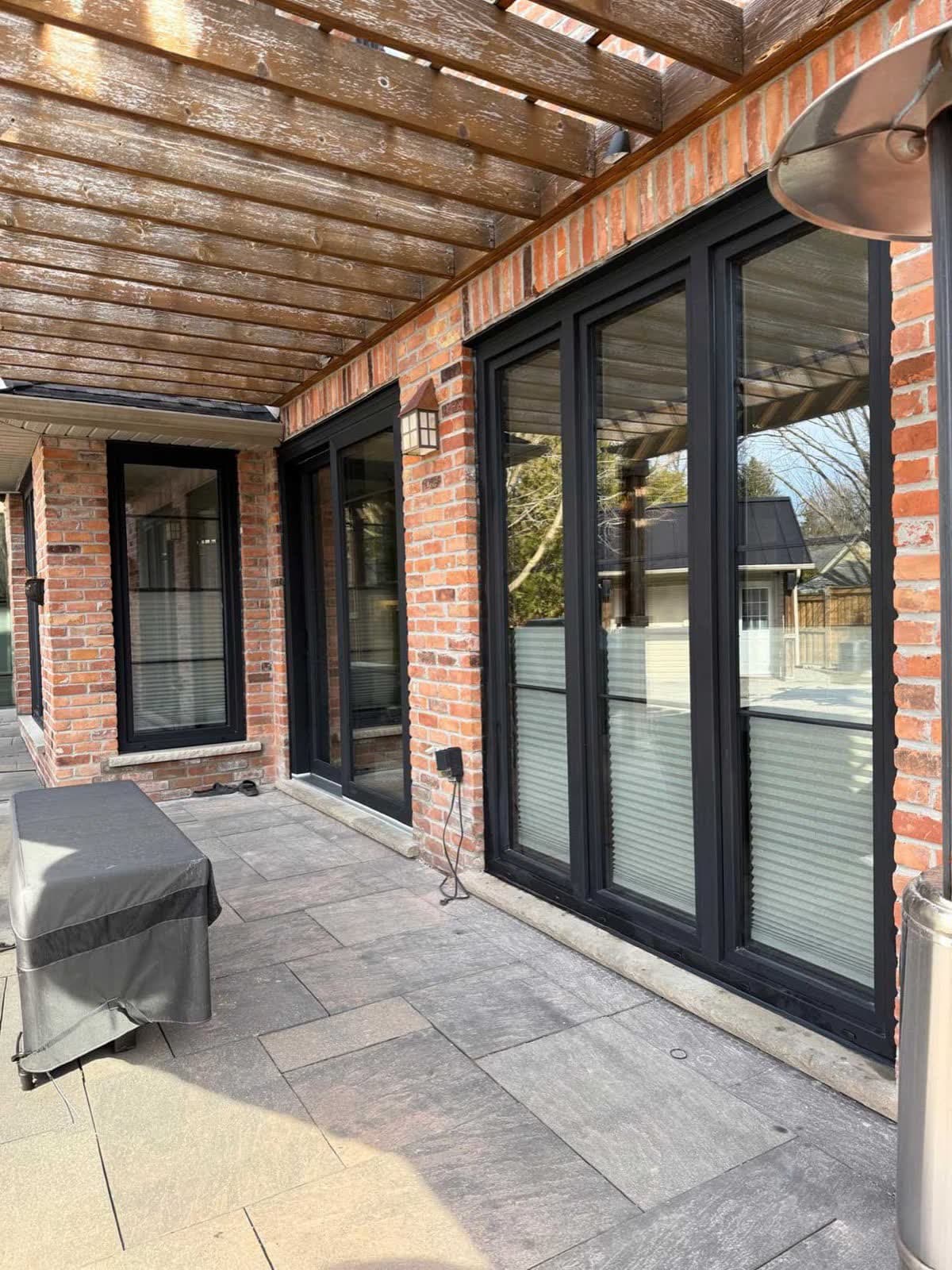
On a 25-foot Toronto lot or a London semi with a postage-stamp yard, the patio door decision isn’t really about style. It’s about space: how much of your deck, your kitchen, or your dining room the door takes up when it’s open. Here’s how French, sliding, and garden doors behave when every square foot counts.
The Swing Problem
A pair of 30-inch French doors that swing out need about 30 inches of clear deck in an arc on each side, which on a small deck is the whole deck. Swing them in and they sweep 30 inches of your dining room, so no table near the door and nothing on the wall beside it. Sliders need zero swing room but block half the opening permanently. Every small-space decision flows from that trade-off.
Your Four Options
Sliding patio door
One fixed panel, one that slides. No swing space, widest clear view, easiest to fit a screen. Opening is half the width. Best for the tightest spaces.
French doors (both swing)
Two hinged panels, both operable. Full-width opening, most traditional look, best air seal. Needs swing clearance in or out. Best when you have a real deck or want the full opening.
Garden door
Looks like French doors, but one panel is fixed and the other swings. Half the swing room of French doors, better seal than a slider, and a screen fits. The small-space compromise. See our garden door guide.
Multi-slide or bifold
Two or more sliding panels that stack, or panels that fold to one side. Opens most of the wall with no swing. Premium price, usually for larger openings. Best for wide openings onto a small patio.
Matching the Door to the Layout
- Door opens onto a small deck with a BBQ and two chairs: slider or garden door. Out-swinging French doors will hit the furniture.
- Door opens directly onto a step or a walkway: slider. Nothing to swing into.
- Dining table within four feet of the door: slider, garden door swinging out, or out-swing French. Never in-swing French.
- Galley kitchen with the door at the end: slider; a swinging door in a narrow kitchen is in the way every time it opens.
- Family room with a big deck and space to spare: French doors, and enjoy the full opening.
- Wide opening (8 feet or more) onto a small patio: a three-panel multi-slide gives a two-thirds opening with no swing.
Light, Glass, and Privacy
On a small lot the neighbours are close. Sliders have the most glass and the slimmest frames, which is great for light and less great for privacy. French and garden doors have more frame, and you can choose glass with grilles or a lower panel to break up the sightline. Frosted or reeded glass on a garden door’s fixed panel is a common small-lot solution.
All patio doors are rated as windows for ENERGY STAR®: U-factor of 1.22 W/m²·K or lower, or ER of 34 or higher. French doors seal by compression and typically rate better than sliders of the same glass.
Screens, Pets, and Kids
Sliders and garden doors take a sliding screen easily. French doors need either a retractable screen or a screen on each panel, and both are more fiddly. If you have a dog that goes in and out all day, a slider with a heavy-duty screen is the practical choice. For kids, sliders can be fitted with a foot bolt or a simple bar; French doors can’t be blocked as easily.
Cost
Installed 2026 Ontario ranges for a standard 5- or 6-foot opening: sliders roughly $2,000 to $4,500; garden doors $2,500 to $5,000; French doors $3,000 to $6,500; multi-slide and bifold from $6,000 well into five figures depending on width. Our sliding vs. hinged guide covers the general comparison in more depth.
Our Recommendation
For most small backyards in London and the GTA: a garden door swinging out if you want the French look and have 30 inches of clear deck beside the door, otherwise a quality slider with a multi-point lock and a heavy screen. Save true French doors for the house with room to enjoy them.
Not Sure What Fits Your Yard?
We'll measure the opening, look at the deck and the room, and show you which door actually works in the space. Free quotes, no commission.