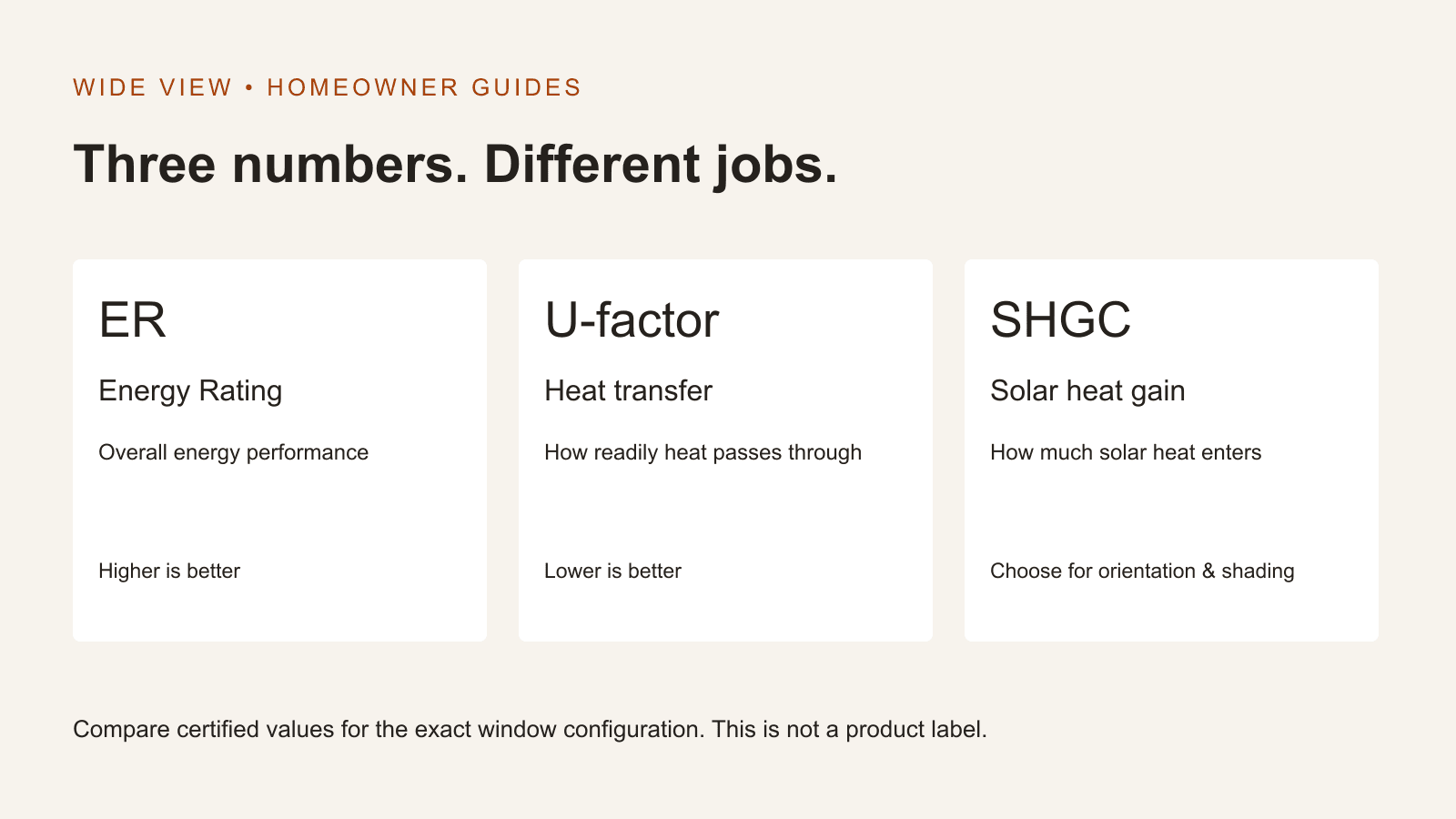
Every window quote in Canada comes with a small alphabet of ratings: ER, U-factor, SHGC, VT, and the ENERGY STAR® logo. Most homeowners nod and move on. That’s a mistake, because two windows with the same price and the same look can differ a lot in how they perform in an Ontario winter, and the label is the only place that difference is written down. Here’s what each number means and which ones to actually use when comparing quotes.
Where the Numbers Come From
Windows sold in Canada are tested and rated under Canadian and North American fenestration standards, including CSA A440.2 and NAFS as applicable. The ratings apply to the whole window (glass plus frame plus spacer), not just the glass, and they’re specific to the exact model and size class. Natural Resources Canada publishes a searchable list of certified products, so any claim on a quote can be checked.
U-Factor
U-factor measures how fast heat passes through the window. Lower is better. In Canada it’s given in W/m²·K; in the U.S. in Btu/h·ft²·°F, which is the same thing divided by about 5.68. A single-pane window is around 5.0 W/m²·K. A basic double-pane is around 2.8. A good double-pane with Low-E and argon is 1.4 to 1.6. Triple-pane with two Low-E coatings can reach 0.8 to 1.0.
If you only remember one number, remember this one. It’s the direct measure of how much heat you lose through the window in January, and it’s the number ENERGY STAR uses as its primary threshold.
Solar Heat Gain Coefficient (SHGC)
SHGC is the fraction of the sun’s heat that gets through, from 0 to 1. A window with SHGC 0.40 lets 40 percent of the solar heat in. Whether you want high or low depends on the wall. In Ontario, free solar heat through a south window in winter is worth real money, so a moderate-to-high SHGC (0.35 to 0.50) on south glass is a good thing. On a west-facing window that bakes in July, a lower SHGC (0.25 to 0.35) keeps the room cooler. Manufacturers offer different Low-E coatings for each situation.
Energy Rating (ER): Canada’s Number
The ER is a Canadian invention that rolls U-factor, SHGC, and air leakage into a single score for a heating-dominated climate. Higher is better. It rewards windows that lose little heat, admit useful sun, and don’t leak. Because it credits solar gain, a window with a slightly worse U-factor but higher SHGC can score a better ER, which is why an ER is a better single number for Ontario than U-factor alone. It also explains why casements often rate higher than sliders with identical glass: the compression seal cuts air leakage and that feeds into the ER.
Typical values: an ordinary double-pane window scores in the low 20s; ENERGY STAR needs 34; the best triple-pane units score in the mid 40s.
Air Leakage and Visible Transmittance
Air leakage is measured in L/s/m² at a test pressure; ENERGY STAR caps it at 1.5. Lower is better, and it’s the number that separates a drafty window from a tight one. Visible transmittance (VT) is how much visible light gets through, 0 to 1. More coatings and more panes lower it slightly; a triple-pane Low-E window might have a VT around 0.45 to 0.55 versus 0.60 for basic double-pane. Most people don’t notice until they see the two side by side.
ENERGY STAR and Most Efficient
Since Version 5.0 took effect in 2020, Canada has a single ENERGY STAR standard for the whole country rather than climate zones. A window or door qualifies with either a U-factor of 1.22 W/m²·K or lower, or an ER of 34 or higher, plus air leakage of 1.5 L/s/m² or less. ENERGY STAR Most Efficient is the top tier: U-factor of 1.05 or lower, or ER of 40 or higher. In practice, Most Efficient means triple glazing.
Certification matters beyond bragging rights. Ontario’s Home Renovation Savings Program rebate requires ENERGY STAR certified models, and the invoice has to name the certified series. See our 2026 rebate guide.
How to Compare Two Quotes
- Ask for the ER and U-factor for each window on the quote, not a brochure’s “up to” figure. Ratings vary by style and size.
- Check the certified product list for the manufacturer and series named. If it’s not there, it’s not certified.
- Compare like with like. A double-pane quote against a triple-pane quote isn’t a price comparison until you account for a U-factor difference of 0.4 or more.
- Look at the spacer. Warm-edge spacers improve the whole-window U-factor and cut edge condensation. Aluminum spacers are a cost-cutting tell.
- Don’t forget air leakage. Two windows can share a U-factor and differ 3× in leakage.
Which Number Matters Most for Your Wall
North wall
U-factor. No useful sun, so pure insulation wins. This is where triple-pane pays back fastest.
South wall
ER. Choose a higher-SHGC Low-E so winter sun helps heat the house.
West wall
SHGC. Pick a lower-SHGC coating to tame summer afternoons.
Busy street
None of the above; ask for the STC rating and laminated glass. See our noise guide.
Want the Ratings Explained on Your Own Quote?
We show ER, U-factor, and SHGC for every window we quote, and we'll compare them against anyone else's numbers with you. No commission, no pressure.