Sliding patio doors are the hardest-working door in most Ontario homes and the one most likely to be sticking, icing up, or leaking cold air by year fifteen. Some of that is fixable in an afternoon for the cost of a set of rollers. Some of it means the door is done. Here’s how to tell which, problem by problem.
Hard to Slide
The most common complaint, and usually the cheapest to fix.
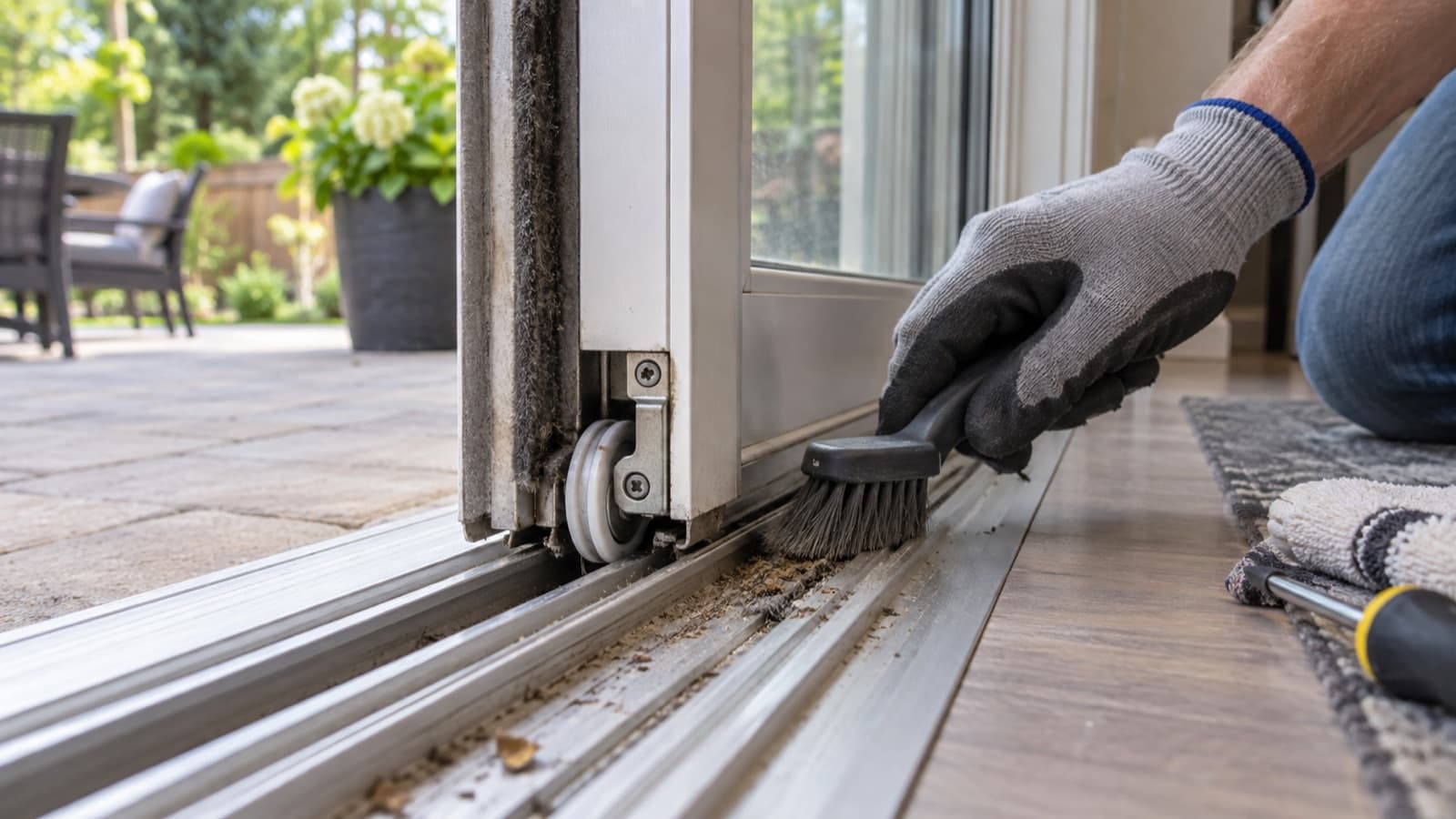
- Dirty track. Vacuum it, scrub with a stiff brush and soapy water, dry, then apply a silicone spray (not oil, which attracts grit). Fixes a third of sticking doors on its own.
- Worn rollers. The wheels under the sliding panel flatten, crack, or seize. Most doors have adjustment screws at the bottom edge; turn them to raise the panel off the track. If adjusting doesn’t help, the rollers need replacing: lift the panel out, swap the roller assemblies, reinstall. Parts are $20 to $60; it’s a two-person job because the panel is heavy.
- Damaged track. A dented or worn aluminum track can be capped with a stainless track cover for $30 to $80, which gives new rollers a smooth surface.
- Frame out of square. If the panel binds at one end and gaps at the other, the frame has settled or the sill has sagged. Adjusters may compensate; if not, this is a replacement sign.
Drafts and Cold Air
Sliders seal with brush or fin weatherstripping that wears out. Check the interlock (where the two panels overlap), the jamb where the panel closes, and the top and bottom of the sliding panel. Replacement pile weatherstrip is inexpensive and slides into a channel. Also check that the panel is adjusted to close tight against the jamb; a panel riding low on worn rollers leaves a gap at the top. Cold air from around the outside of the frame, behind the casing, means the perimeter was never insulated; pull the interior trim and foam it. If the door is old aluminum with no thermal break, the frame itself conducts cold and no weatherstripping will fix it.
Ice and Frost on the Track or Glass
Ice in the bottom track is condensation from warm indoor air meeting a cold aluminum sill, then freezing. It’s worst on old doors without a thermal break and in humid houses. Lower indoor humidity (see our condensation guide), keep the track clean so water drains through the weep holes, and clear the weep holes on the exterior. Frost on the glass edges means the sealed unit has a poor spacer or the glass is single-pane; frost across the whole glass means humidity is far too high. If the track ices every winter regardless, the door is the problem.
Water on the Floor
First check the simple cause: the weep holes in the exterior face of the sill are blocked, so rain that gets into the track can’t drain out and instead comes over the inside lip. Clear them with a wire. If water still comes in, the sill pan or the flashing under the door has failed, or the exterior caulking between the frame and the wall has opened up. Recaulk the exterior perimeter. Persistent leaks under the sill usually can’t be fixed from outside and mean the door should come out so the opening can be re-flashed. Don’t ignore this one; water under a patio door rots the subfloor.
Lock and Handle Problems
A latch that won’t catch is almost always alignment: adjust the rollers so the panel meets the keeper squarely, or move the keeper. Handles and mortise locks are replaceable parts on most brands; bring the old one to a door hardware supplier. If the lock is the flimsy hook type on an older door, a supplementary foot bolt or a security bar is a cheap upgrade.
Fogged Glass
Moisture between the panes means the sealed unit has failed. On a door with a sound frame and rollers, the glass unit alone can be replaced, typically $400 to $800 for a standard panel. On a door that also sticks, drafts, and ices, that money is better put toward a new door.
Repair Costs in Ontario
| Repair | DIY parts | Professional, GTA/London |
|---|---|---|
| Track cleaning and lubrication | $10 | Included with any service call |
| Roller replacement | $20–$60 | $150–$400 |
| Track cap | $30–$80 | $150–$300 |
| Weatherstripping | $20–$40 | $100–$250 |
| Handle and lock set | $40–$120 | $150–$350 |
| Sealed glass unit | n/a | $400–$800 |
| Rollers, track, and weatherstrip together | $100–$180 | $350–$650 |
When to Replace Instead
Replace the door when two or more of these are true: the frame is aluminum with no thermal break, the frame is out of square, the sill or subfloor is soft, the glass is fogged, the track ices every winter, or the repair estimate is more than a third of a new door. A new sliding patio door in Ontario runs about $2,000 to $4,500 installed, comes with a multi-point lock, Low-E glass, and a thermally broken frame, and qualifies for the $100 rebate as an ENERGY STAR® opening. If space allows, a garden door is worth considering at the same time; our garden door guide explains why it seals better.
Patio Door Sticking, Icing, or Leaking?
We'll tell you whether it's a $200 fix or a door that's finished, and quote the replacement only if it's warranted. No commission.