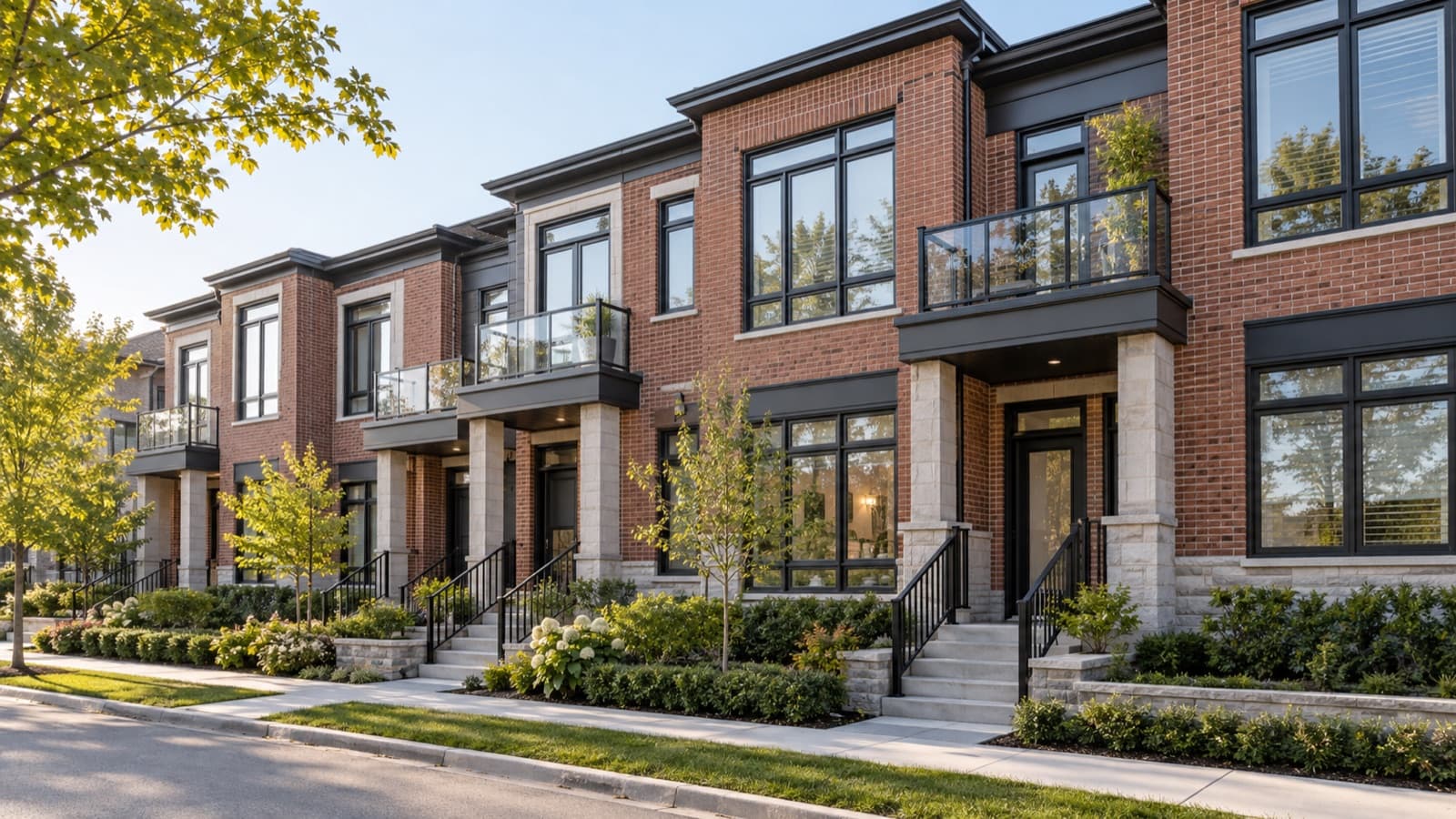
If you own a condo townhouse, a stacked town, or a unit in a low-rise building in the GTA or London, replacing your windows is not just a purchasing decision. In most cases the windows aren’t entirely yours to replace, and doing it without the corporation’s sign-off can end with an order to take them out. Here’s how the Ontario rules work, who pays for what, and how to get a window project approved.
First: Freehold or Condominium?
Many GTA townhouses look identical but are legally different. A freehold townhouse is yours to the lot line; you can replace your windows like any homeowner, subject only to municipal permits and any registered restrictive covenant. A condominium townhouse, including “common elements” or parcel-of-tied-land (POTL) condos where you own the house but share roads and landscaping, is governed by the Condominium Act, 1998 and by the corporation’s declaration. Check your deed or status certificate: if there’s a condominium corporation number, the rules below apply.
Who Owns the Windows
In most Ontario condominiums, windows and exterior doors are common elements, or exclusive-use common elements, because they form part of the building envelope. The declaration says exactly where the unit boundary falls; a common formula puts the boundary at the interior face of the glass, so the frame and the glass belong to the corporation. Some declarations, especially for newer townhouse condos, make windows part of the unit. There’s no way to know without reading the declaration, which you can get from the corporation or your status certificate.
Who Pays
- Windows are common elements: the corporation is responsible for repairing and replacing them, funded by the reserve fund. Owners can’t simply replace them on their own, and the corporation decides the timing, typically as a building-wide project.
- Windows are part of the unit: the owner maintains and replaces them, but exterior appearance is still usually controlled by the declaration and rules, so approval is still needed for anything visible.
- Owner wants an upgrade before the corporation’s schedule (triple-pane, black frames, a different style): the owner pays, and the work is done under a Section 98 agreement.
Section 98 Agreements
Section 98 of the Condominium Act is the mechanism that lets an owner alter common elements. The board can approve an owner’s change if it doesn’t detract from the appearance of the building, doesn’t adversely affect other units, doesn’t increase the corporation’s costs, doesn’t affect structural integrity, and doesn’t breach the declaration, by-laws, or rules. Once the board passes a resolution, the owner and the corporation sign a Section 98 agreement that is registered on title. It sets out who owns the alteration, who maintains and insures it, who pays if it fails or damages something, and what happens when the corporation eventually replaces all the windows. The agreement binds future owners of the unit.
Getting Approval: Step by Step
- Read the declaration and rules on windows, exterior alterations, and colour.
- Ask property management whether a building-wide replacement is planned; if it’s within a few years, waiting may be cheaper.
- Get a written quote and specifications from a contractor: product, colour, style, glass, and installation method, with drawings if the board wants them. We prepare these routinely.
- Submit a written request to the board with the quote, spec sheets, proof of the contractor’s insurance and WSIB coverage, and a proposed schedule.
- Board resolution and Section 98 agreement. The corporation’s lawyer usually drafts it; expect to pay their fee, often $500 to $1,500, plus registration.
- Install, then notify management for any inspection the agreement calls for.
What Boards Usually Require
- Uniform exterior appearance: same exterior colour, style, and grille pattern as the building standard, even if you upgrade the glass or interior colour.
- A pre-approved product or equivalent, where the corporation has done a prior replacement.
- Insured, WSIB-covered contractors with the corporation named as additional insured on some projects.
- Work hours and access rules, elevator bookings in mid-rise buildings, and protection of common areas.
- Engineer sign-off for anything touching the envelope in a mid- or high-rise, especially above the second floor.
Organizing a Group Replacement
The most economical route is often for several owners, or the corporation itself, to replace windows together. Per-window cost drops with volume, one Section 98 template covers everyone, and the exterior stays uniform. If you’re on the board, get two or three contractors to quote the whole building with a per-unit price so owners can see it. If you’re an owner, ask management whether others have asked; a few interested owners is often enough to get a project onto the board’s agenda.
Mistakes That Get Owners in Trouble
- Replacing windows without approval because “they’re on my unit.” Boards can and do order removal at the owner’s expense.
- Changing the exterior colour or grille pattern.
- Using a contractor without proper insurance, which the corporation’s insurer will refuse to cover if something goes wrong.
- Assuming a verbal OK from a manager is board approval. It isn’t; you need a resolution and, for common elements, a registered agreement.
- Forgetting to disclose the Section 98 agreement when selling; it’s on title and shows up in the status certificate.
For freehold townhouses and semis, the usual rules apply; see our quote guide and cost guide.
Condo or Townhouse Windows?
We prepare the specifications and insurance documents boards ask for, and we quote group projects per unit. Serving London, Mississauga, Oakville, and the GTA.